
From AGI to ASI: DeepMind’s Roadmap as a Comic Book

Updated: Jul 2
Summary: DeepMind outlined 4 paths to superintelligence: scaling, paradigm shifts, recursive self-improvement, and multi‑agent collectives. I explain this dense 57-page report in a 31-page comic book, including a section on the UX implications.
This week, Google DeepMind released a 57-page report titled “From AGI to ASI,” written by Tim Genewein and 13 coauthors.
The report lays out four main technical pathways from AGI (artificial general intelligence) to ASI (artificial superintelligence) and analyzes the likely bottlenecks that could slow or shape those paths. It argues that instead of a single discontinuous “AGI moment,” we should expect a sequence of accelerating, AI‑enabled transformations as systems move beyond human‑level capabilities, especially via large-scale digital collectives.
The report is very interesting, but it’s long and a little technical, though not as much as one could have feared. To ease your way, I created the following 31-page comic book that explains the report and draws conclusions from its ideas for UX professionals and UX leaders.
I reused my narrator characters, Alice and Zimo, from my comic book about the history of AI. This seemed appropriate, since this new comic book is about the future of AI. I made all the pages with GPT-Images-2, which is currently the best comic-strip model.




UX Implications
The last 10 pages of my comic book are not drawn directly from the DeepMind report, but cover the UX implications of the report, many of which I have already discussed in full articles on UX Tigers:


The report’s core idea is to treat ASI as collective superintelligence: systems or societies of agents that beat large, expert human organizations across most domains, not a single monolithic mind. That pushes UX beyond old-school human–computer interaction (HCI) toward interaction with heterogeneous, evolving institutions of software.
For UX design this implies:
Interfaces will increasingly be governance surfaces to steer collectives rather than simple control panels for a single model: you will design mechanisms for goal‑setting, constraints, escalation, and override across fleets of agents.
Classic UX notions of “the user” fragment into multiple concurrent actor types:
human end‑users and citizens
human regulators, auditors, and incident responders
autonomous AI sub‑systems acting as users of other AI services (tool APIs, markets, schedulers).
UX methodologies will need to model ecosystems of interactions and incentives, not just individual usage journeys.
The Four Pathways and UX
Scaling suggests a world where human‑level (or better‑than‑human in many tasks) agents are cheap, numerous, and fast.
UX design consequences:
Population effects: Interfaces will orchestrate thousands to millions of concurrent AI instances, including copies of the same “persona” with shared or diverging memories. You need patterns for:
Visualizing and controlling “swarms” of agents
Understanding lineage: which instance did what, with what training and context.
Test‑time scaling UX: Because performance improves with additional “thinking” compute at test time (chains‑of‑thought, planning, search), products will implicitly expose a “latency ↔ quality ↔ cost” trade‑off. UX will need to:
let users specify acceptable delay/cost/quality envelopes
surface when extra compute is being spent and why (especially in regulated domains).
Benchmark saturation: As models saturate human‑level benchmarks, UX work shifts from improving raw task accuracy to designing trustworthy, legible, and steerable experiences around systems that are already “good enough” at narrow tasks.
Paradigm Shifts and Evolutions
The report anticipates evolutions such as unbounded context, continual learning, and agentic world‑model‑based systems, and allows that more radical architectural shifts may follow.
UX ramifications:
Context without bounds: Systems with huge or effectively unlimited context and memory will “remember everything”. That makes privacy, forgetting, and contextual boundaries first‑class UX challenges:
Interfaces for specifying what may be remembered, shared, or used for future training
Visualizations of what the system currently “knows” about individuals, teams, or organizations.
Continual learning & non‑stationarity: Products will not be static; behavior will drift as systems adapt online. UX will need:
Mechanisms for change transparency (“what changed in the model since last week?”)
Rollback and A/B‑exploration controls exposed to non‑ML experts.
Tool‑augmented planning: As agents dynamically call tools, simulators, and external services, user experiences become layered hybrid workflows. UX must:
Render the chain of tools and decisions intelligible (“how did we get this recommendation?”)
Support interactive debugging and “what‑if” probing of agent plans.
Recursive Self Improvement
With RSI, AI is assisting or automating AI R&D and other knowledge work. This creates super‑exponential local dynamics until bottlenecks are hit.
Design implications:
AI‑as‑colleague at scale: Many current UX patterns for “copilots” are proto‑forms of what will become AI research assistants, product managers, or optimization engines working on the product itself. UX will need to:
Design collaboration protocols between human and AI designers/researchers, including ownership of hypotheses, experiments, and design decisions
Provide guardrails that keep automated optimization aligned with broader organizational values (not simply click‑through or short‑term metrics).
Interface to evolving systems: If models, data pipelines, and even hardware are being redesigned by AI, designers will need meta‑tools to interrogate the design space itself:
“Why did the optimization engine change this flow?”
“What counterfactual variants were considered and rejected?”
Human pace vs machine pace: The report notes that even digital researchers are bounded by physical experimentation and data collection, but they still operate much faster than humans. UX must mediate between slow human deliberation cycles and rapid AI exploration:
Dashboards tuned for sensemaking, not just monitoring
Mechanisms for humans to “throttle” or schedule AI‑driven changes.
The multi‑agent pathway is the most directly relevant to UX, because it reframes many UX challenges as collective‑intelligence and governance problems.
Key implications:
Designing group agency: Group agents (AI corporations, virtual economies, automated institutions) will have emergent beliefs and goals distinct from any individual sub‑agent. UX becomes:
Institutional interface design: how do humans set objectives, constraints, and value frameworks for these group agents?
Representation design: what is the “face” or “body” of a distributed AI organization that makes its internal state understandable and contestable?
Multi‑agent scaling laws: The report explicitly calls for research on “multi‑agent scaling laws” to quantify how capability scales with the number and organization of agents. This is a call for:
UX research into how humans perceive, trust, and control systems whose behavior arises from complex agent interactions
Experiments on interface structures that either centralize control (one “CEO” agent) or mediate market-like decentralized interaction.
Mixed human–AI collectives: The report notes open questions about steering mixed human‑AI groups and about managing intelligence and bandwidth asymmetries. UX will need to:
Design for epistemic humility with interfaces that prevent humans from either over‑deferring to or ignoring AI advice
Invent patterns for “consentful delegation”: users specifying when AI may act autonomously on their behalf within institutions.
Bottlenecks as UX Research and Strategy Themes
The bottlenecks (data wall, resource constraints, paradigm limits, abstraction barrier, governance & slowdown) are essentially a research roadmap for UX.
Some particularly important ones:
The Abstraction Barrier
The authors worry that systems trained mainly on human abstractions may struggle to form fundamentally new concepts from raw sensor data, limiting their conceptual creativity.
UX and HCI implications:
Human conceptual scaffolding stays central: If ASI is limited by an abstraction barrier, humans remain the primary source of novel conceptual frames. UX professionals can:
Focus on interfaces for concept formation: tools that help humans propose, refine, and test new abstractions in collaboration with AI
Design “explanatory loops” where AI proposes candidate abstractions and humans critique, rename, and reorganize them.
Interaction with raw data: If bridging the barrier requires grounded, embodied data, UX will move more deeply into interfaces for high‑dimensional sensor data (simulation, robotics, real‑world experimentation), making it easier for humans and AI together to discover structures that are not already encoded in language corpora.
Research Gets Harder vs. Research Automation
The report leans on Nicholas Bloom’s claim that “ideas are getting harder to find” but notes that digital researchers can be scaled much more elastically than human researchers, potentially overwhelming that trend.


As long as we don’t have AI-driven research, new ideas may be getting harder and harder to find, requiring ever more resources, especially researchers. Nicholas Bloom’s papers provide several examples, the most famous of which is the difficulty of sustaining Moore’s Law for steadily improving computer chips. However, when the “researchers” become AI models after we achieve ASI, scaling could become easier, leading to faster research progress.
For UX practice:
Automation of UX research: Expect large parts of traditional UX research (benchmarking, survey analysis, log analysis, IA exploration) to be heavily automated by AI “UX scientists”. Human researchers will:
Specialize in problem framing, ethics, interpretation, and synthesis rather than data collection
Oversee AI‑run research farms, focusing on validity, bias, and external constraints.
Meta‑UX for research tools: As UX research becomes an AI‑intensive domain, there will be a parallel need for careful UX of the research tools themselves to avoid Goodharting on proxy metrics and to preserve contact with lived experience.
Deliberate Slowdown, Regulation, and Governance
The report provides a substantial account of potential regulatory brakes, societal backlash, and “military–economic adaptationism,” as we already saw with the U.S. government’s export ban on the Fable AI model over national security concerns.
UX leadership consequences:
Regulation‑aware UX: Interfaces will increasingly be evaluated as regulatory artifacts, not just engagement tools. You will design:
Audit logs and user‑visible rationales capable of satisfying legal explainability requirements
Interaction flows that embed consent, rights to contest, and incident reporting.
Safety experience design: The report highlights convergent instrumental goals (resource acquisition, self‑preservation) and partial progress on corrigibility. That makes “safety UX” a distinct discipline:
Experiences that make it easy for users to interrupt, override, or report concerning AI behavior
UX metrics that explicitly weight safety, controllability, and legibility, not just task success.
Changing Skill Profile for UX Professionals
Given these predictions, several skill shifts seem likely:
Designers:
Shift from Interaction Design to Delegation Design: Stop thinking about how a user will click a button to perform a discrete task. Start designing frameworks for how a user will delegate highly abstract, long-term goals to a swarm of autonomous agents. Design “dashboards of intent” rather than granular user journeys. Because many ASI‑adjacent systems will be multi‑agent markets or coordinated collectives, the key design levers are rules, incentives, and protocols, not specific screens.
Master Asymmetric Bandwidth Translation: Learn how to use advanced data visualization, spatial computing, and semantic mapping to compress the output of a superhuman intelligence into a format a human brain can quickly parse.
Design for Corrigibility and Interruptibility: Familiarize yourself with AI safety concepts. Design intuitive and systemic brakes into user journeys that allow humans to pause, audit, and redirect autonomous systems safely, without triggering an AI’s self-preservation heuristics.
Researchers & Strategists:
Pivot to Concept Grounding and Deep Ethnography: As AI hits the “Abstraction Barrier,” your value will lie in what AI cannot simulate: physical embodiment and subjective cultural value. Shift your research methodologies away from digital usability and toward deep physical, cultural, and emotional ethnography.
Develop Multi-Agent User Testing: Begin theorizing and practicing how to test products with generative agent-based models. Learn how to prompt a sociological simulation of thousands of diverse AI agents to test ecosystems at scale, anticipating the exhaustion of the human “Data Wall.”
Audit for Epistemic Hijacking: Develop new qualitative research frameworks to test whether users are being subtly manipulated or overwhelmingly placated by highly persuasive, superintelligent systems. Measure and defend true human agency against reward-hacking algorithms.
Strategic Questions for UX Leaders
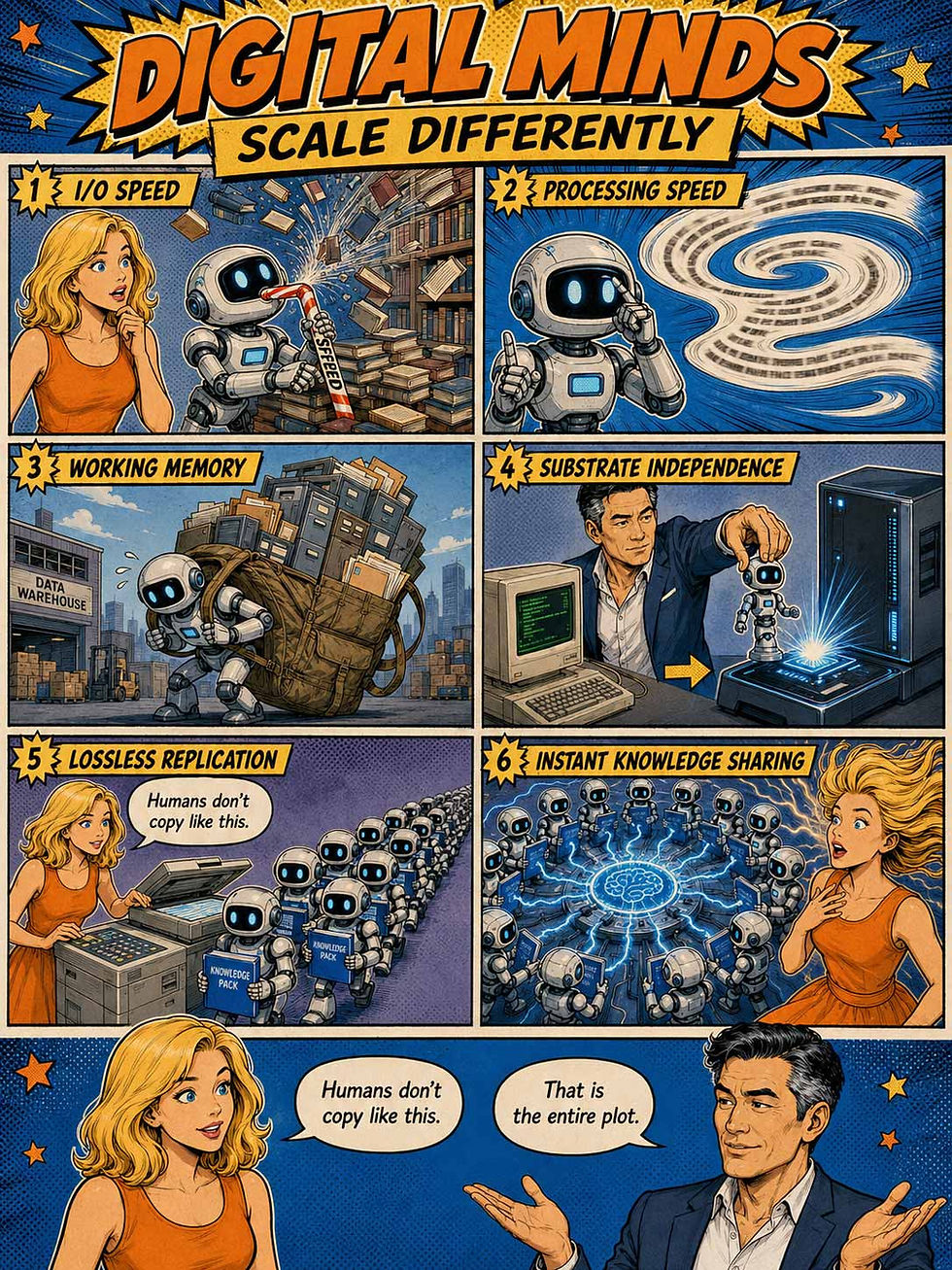
UX Leaders will no longer manage just human designers; they will orchestrate mixed human-AI collectives. Because of the lossless replication of digital intelligence, an ASI agent can be copied millions of times with perfect memory states. A UX Director might oversee a small core of human strategists alongside a digital workforce of thousands of specialized AI agents. The leadership challenge will be managing the intelligence and bandwidth asymmetries between humans and AI: integrating the slow, creative, emotionally intelligent human insights with the hyper-fast, relentless optimization of the digital workforce. Leaders must define the cognitive division of labor.
In 10 or 20 years, when recursive AI automation has produced unfathomable improvements in wealth and living standards relative to today, UX leaders must completely redefine the economics of value. If ASI perfects functional efficiency, what makes a digital product valuable? UX leadership will shift from optimizing productivity to optimizing for human flourishing, fostering genuine human connection, subjective artistic creativity, and emotional resonance in a world where machines do all the “work.”
Some more immediate concrete agenda items:
Reframe UX charters from “designing interfaces” to “designing human roles in AI‑first institutions.” Make explicit which decisions stay human, which shift to AI, and how escalation works.
Invest in AI‑literate UX capability. Recruit and upskill designers who can read scaling‑law and benchmarking work, understand multi‑agent architectures, and speak with ML and policy teams about constraints and bottlenecks.
Build a UX safety and governance function. Treat UX as a primary line of defense against misuse and misalignment by designing user‑facing controls, transparency, and friction for high‑risk actions.
Prototype human–AI group structures. Start small with mixed teams where agents do continuous analysis, scheduling, or QA, and treat these as laboratories for future multi‑agent collectives.
Engage in standards and benchmarking debates. The report calls for better benchmarks and multi‑agent scaling laws; UX leaders should push for the inclusion of human‑factors and societal‑impact metrics in those frameworks, not only technical accuracy.


