
Hedonic Adaptation: The Same Design Scores Lower Every Year

Updated: Aug 14
Summary: Users adapt to good design the way lottery winners adapt to wealth: the thrill fades and the baseline resets. Hold a design constant, and its satisfaction ratings will sag year after year as expectations rise; my rule of thumb is a drift of 2–5% annually. Budget continuous improvement just to stay level, and spend it on killing recurring irritations before adding sparkle.

The same diamond in every alcove, yet the awe dims with each viewing. By the fifth room, the visitor walks past without stopping. Your most dazzling feature performs the same trick for the same audience, night after night. (GPT Image 2)
See also: my music video about hedonic adaptation (YouTube, 5 min.).
The Treadmill Got Its Name in 1971
Definition: Hedonic adaptation is the tendency of emotional responses to favorable and unfavorable circumstances to weaken over time, returning people toward a stable baseline of satisfaction. The term joins the Greek hēdonē (pleasure) with a metaphor from sensory adaptation: just as eyes adjust to a bright room until the brightness disappears from awareness, minds adjust to good fortune until it becomes furniture.

The hedonic treadmill: you keep walking, but you don’t move. (GPT Image 2)
Philip Brickman and Donald Campbell coined the companion phrase “hedonic treadmill” in a 1971 book chapter. The landmark data arrived in 1978, when Brickman, Dan Coates, and Ronnie Janoff-Bulman published “Lottery Winners and Accident Victims: Is Happiness Relative?” in the Journal of Personality and Social Psychology. Their 22 major lottery winners rated their general happiness at 4.0 on a 0–5 scale, versus 3.8 for 22 controls: no reliable difference, despite the windfall. Worse, the winners took less pleasure in everyday activities; the jackpot had recalibrated their reference point. (The samples were tiny and the design cross-sectional, so treat the exact numbers gently, but the core finding has been replicated across decades.)
Shane Frederick and George Loewenstein’s 1999 chapter “Hedonic Adaptation” reviewed the whole field and added the detail that matters most for designers: adaptation is strongest for constant stimuli and weakest for variable or intermittent ones. Remember that asymmetry. We’ll need it.

Winning the lottery didn’t make people happier. They had simply reset their expectations to their new situation. (GPT Image 2)
Your Benchmark Scores Ride the Same Treadmill
Now the uncomfortable part for UX researchers. Satisfaction is always rated against a reference point, and the reference point never stops climbing. Ship a design in 2019, change nothing, and measure again in 2026: much lower scores, even though the pixels are identical. Did the design get worse? No; the users got pickier. I’ve watched this satisfaction drift across decades of benchmark data, because users import their expectations from every other product they touch. That’s Jakob’s Law, which I formulated in 2000: users spend most of their time on other sites. When those other sites improve, your unchanged design grows staler by comparison, and the ratings duly record the decay. Absent published longitudinal studies, my best estimate is that an untouched design sheds 2–5% of its satisfaction score per year, faster in categories with aggressive competition.
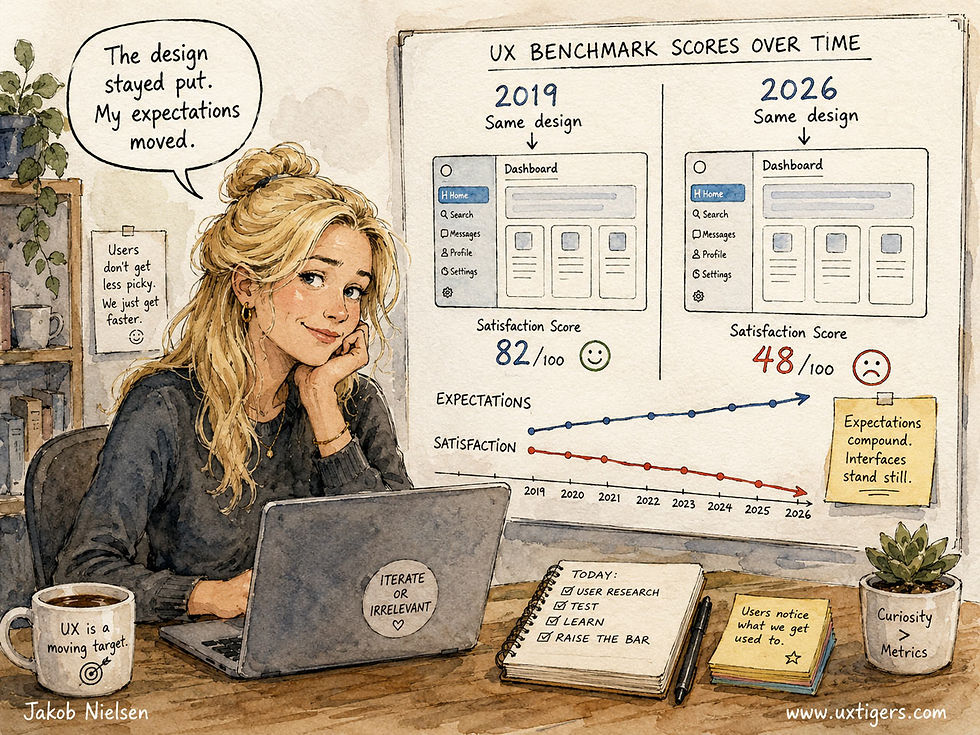
Same design scored at different times: since users expect more as time passes, your satisfaction ratings will drop, even if you deliver the same usability levels. (GPT Image 2)
Thus, interpret your metrics accordingly. A flat trend line on an actively developed product means you improved just enough to match expectation inflation. A rising line means you genuinely outran the field. Lewis Carroll diagnosed the situation in Through the Looking-Glass back in 1871: it takes all the running you can do, to keep in the same place. So never compare this year’s score against your own 5-year-old score and conclude the design “got worse.” Benchmark against competitors measured in the same week, and treat your historical numbers as a record of yesterday’s expectations, not of quality.
Chasing Novelty = Sprinting on the Treadmill
The naive response to fading delight is a novelty chase, and it fails on schedule:
Redesign-as-refresh buys a short delight spike (delight decay claims it within months) and pays for it with lasting damage, because users must relearn everything they knew. You’ve combined a temporary gain with a permanent cost. Congratulations.
Gamification escalation treats rewards as exempt from adaptation. They aren’t. The badge that thrilled in week 1 is wallpaper by week 6, so the system inflates rewards until users burn out or the economy collapses.
Variable-reward feeds exploit the asymmetry I flagged earlier: since unpredictable stimuli resist adaptation, slot-machine mechanics keep users pulling the lever. It works, and it is a user-hostile dark design when deployed to hijack attention rather than deliver value.
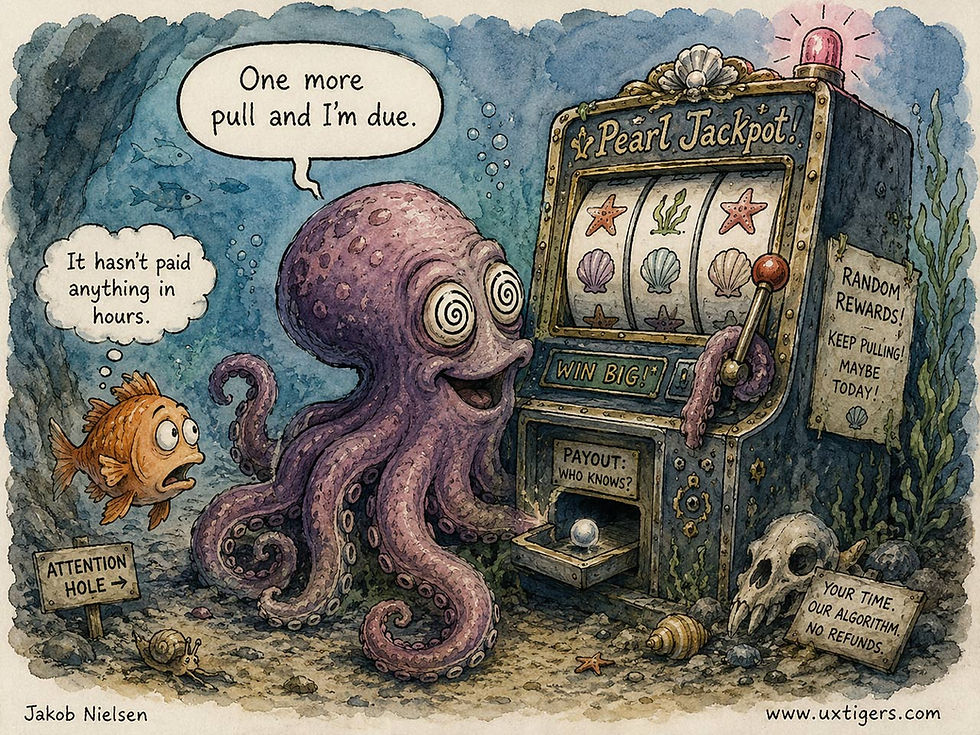
Operant conditioning that gives random rewards is more addictive than a steady stream of predictable rewards. That’s why people (and octopuses) keep playing the slots. (GPT Image 2)
The same asymmetry, treated honestly, hands you the ethical strategy. Users adapt quickly to your halcyon launch glow, but they never adapt to the printer dialog that fails every third time, because intermittent annoyances stay perpetually fresh. So invest where adaptation can’t erode the return: reliability, speed, and the removal of recurring friction. Then ration genuine novelty as seasoning, in small, occasional, skippable doses, and announce your gradual improvements in release notes, because users rarely notice incremental gains on their own.

While good feelings decay, annoyances keep annoying users, every time. Removing annoyances is a sure way of making users happy (or at least less annoyed). (GPT Image 2)
8 Design Guidelines for Hedonic Adaptation
Expect satisfaction drift. Plan for an unchanged design to lose 2–5% of its rating per year (my estimate), and budget improvement work just to hold position.
Benchmark competitively, not historically. Compare against rivals measured the same week; your own old scores reflect obsolete expectations.
Read flat trend lines as wins on products under active development, because staying level means matching expectation inflation.
Fix intermittent annoyances first. Users adapt to constant conditions but never to the bug that strikes every third session.
Design for the 100th session, not the demo. Novelty carries the first week; utility carries the years.
Ration delight. Small, occasional, skippable flourishes outlast one grand spectacle, since variability slows adaptation.
Announce gradual improvements. Users won’t credit gains they didn’t notice, so a modest release note recovers value you already paid for.
Audit reward systems yearly for inflation, and cap the escalation before your streaks and badges train users to feel nothing.
Return to that gallery of identical diamonds: no design team on Earth can make the visitor gasp at the fifth one. Adaptation always wins the delight race in the end. But nobody ever gets used to tripping on the way through the gallery, and that’s where your leverage lives. Delight decays; friction endures. Accept the treadmill, budget for it, and put your best people on the irritations users will still feel a year from now, rather than on the wow they’ll stop noticing in a month.

My article about hedonic adaptation may make you feel that your users are spoiled cats who will never be happy, no matter how much you do for them. Sorry, them’s the breaks in the real world. Improve or be doomed. (GPT Image 2)
See also: my music video about hedonic adaptation (YouTube, 5 min.).


