
Redesigning Workflows for AI

Summary: In a controlled field experiment, startups that redesigned end-to-end workflows around AI generated 90% more revenue than equally equipped peers that used AI mainly to speed up individual tasks.
Two exciting developments in the intersection of AI and UX happened in the first quarter of 2026. Most influencer attention has been lavished on the first, which actually took off in the last week of 2025: the fact that AI has advanced enough that it is the main, or soon only, way to implement software. Several of the world’s leading software engineers have recently declared that AI now writes better code than they do.
This change has upended the profession of software engineering, changing the work from programming to management duties: the agency of deciding what should be done, the judgment to assess how well the AI did, and distributing the workload among AI agents and overseeing their progress.
Big changes. But the second development is even more important for business at large: we now finally have evidence of how to make AI implementations profitable in companies, and early data shows that the business impact of proper AI implementation is immense. It does not come mainly from making isolated tasks faster. It comes from redesigning whole workflows so AI can absorb, reorder, or eliminate entire chains of work.
Bottom line: profitable AI is workflow redesign, not task optimization.
Workflow redesign is key to profitable AI use in companies. (NotebookLM)
Consider a 10-step workflow where each step requires 10% of the total time. If AI doubles an employee’s productivity on just one step, that step now takes 5% of the total time. The overall workflow time drops only to 95%. Doubling task-level productivity yields a mere 5% systemic improvement. You haven’t transformed the business; you’ve merely hurried the work along to the next bottleneck, a much less profitable outcome.

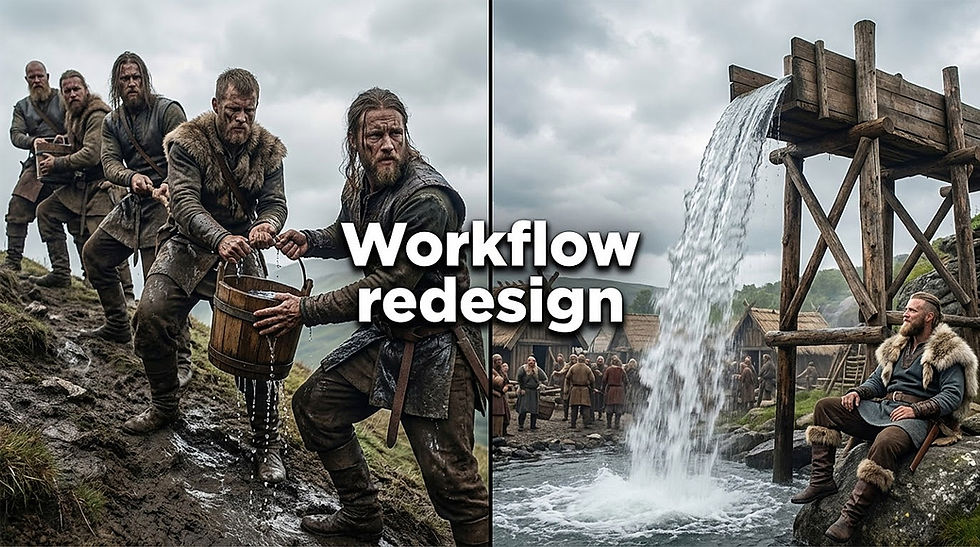
Give an individual worker a sharp new tool, and he or she may be able to perform a particular task faster, leading to higher localized productivity. However, performance across the entire firm is what creates profits, and improving scattered tasks won’t suffice. (NotebookLM)
In operations terms, task productivity is a local efficiency gain; workflow redesign is a throughput gain. The first makes one station faster. The second changes the system by removing handoffs, parallelizing work, or moving humans to exceptions. That distinction matters because firms often celebrate local AI wins that never show up in cycle time, margin, or revenue.

Every handoff causes delays and creates opportunities for error. (NotebookLM)
Task-Level AI Productivity
Before turning to workflow redesign, let’s briefly review how AI improves productivity on the task level.
Modern AI, including models like OpenAI's GPT-5.4 Pro, Google’s Gemini 3.1 Pro, and Anthropic’s Claude Opus 4.6, can be expected to increase employees’ task throughput by around 38%. This counts how many times people can complete a given task within a given time (e.g., a workday) with AI assistance, relative to how many times they could do the task without AI.
Even better, the quality of the work tends to improve with AI, even though the employee spent less time completing the task. For example, GDPval is a benchmark of “economically valuable tasks” that usually take a human expert a few hours to complete. The benchmark is scored by independent human experts in each domain, who judge whether an AI or a human expert performed best on a task. In December 2025, GPT 5.2 Pro performed better on 60.0% of the tasks. Humans were still better on 25.9% of the tasks, and 14.1% of the tasks were tied. In other words, on this measure of valuable work performance, AI was already twice as good as humans in December 2025, and better models have been released since then.
Despite these strong benchmarks for AI task productivity, AI has been curiously absent from measures of companies’ business performance, such as overall GDP growth or individual company profitability.
An over-hyped report from MIT Media Lab Project NANDA in July 2025 has been frequently cited for a claim that 95% of enterprise AI projects fail. This particular report is very weak. As Wharton Business School professor Kevin Werbach pointed out, the report actually says that 5% of “custom enterprise AI tools” have been “successfully implemented.” But that's much narrower. As R. Scott Raynovich pointed out, the report also stated that 50% of the surveyed companies had piloted a general-purpose AI (remember this was about a year ago), and that 40% of respondents (i.e., 4/5 of those that tried) had been successful. Furthermore, the report used an absurdly narrow definition of “success,” requiring demonstrable P&L impact within approximately six months, which is unrealistic since enterprise technology transformations routinely require 12–18 months to show measurable value. Finally, the report dismisses the extensive “shadow use” of AI, where employees use their own AI tools outside of formal company IT approval processes. The report’s own data reveals that over 90% of employees use such “shadow” personal AI tools at work, yet it completely dismisses whatever positive outcome these employees must be realizing to pay for personal AI for work use. As Dave Kellogg observed, the study effectively says, “excluding the area that’s working really well, it’s not really working.”

“Shadow AI” is the problem of employees using AI tools without telling management (or each other), because they are using unauthorized AI while the official management process is bogged down in committee meetings about last year’s AI. While shadow AI gets some jobs done, the hidden nature prevents organizational learning. (NotebookLM)
Reframe shadow AI and the picture flips: it’s not a compliance problem, it’s an unpaid R&D lab. Those 90% of employees are already solving the mapping problem in the wild, discovering exactly where AI absorbs friction in real workflows. The control group in the INSEAD experiment failed precisely because they lacked this map. Instead of banning shadow tools, the winning move is to harvest them: run monthly “show me your prompt” sessions, anonymize and cluster the patterns, then promote the most repeated hacks into official workflow redesigns. Shadow use is a messy signal, but it’s the only signal that tells you where the real handoffs hurt.
Given these many weaknesses, I don’t believe the headline number that 95% of company AI use failed during the first half of 2025. But I do believe that companies didn’t realize much profitability growth from AI last year. I even believe that this is still the case for most companies today. But the reason for the lack of AI profitability is the focus on task-level productivity and a refusal to redesign entire workflows for AI.
Empirical Research on Workflow Redesign
A new INSEAD/Harvard Business School paper, “Mapping AI into Production: A Field Experiment on Firm Performance,” provides causal evidence that profiting from AI is not mainly a prompting or access problem. It is a workflow-design problem: firms must discover where AI can reorganize the production system, which the authors call the mapping problem.

The “mapping problem” is the central managerial friction in AI adoption: the challenge of discovering exactly where and how artificial intelligence creates value within a production process. (NotebookLM)
I made a short explainer video summarizing the main points of this research (YouTube, 5 min.).
Conducted by researchers Hyunjin Kim, Dahyeon Kim, and Rembrand Koning, the research was structured as a massive randomized field experiment involving 515 high-growth startups participating in a global, three-month virtual accelerator program known as the AI Founder Sprint.
All 515 startups, spanning the Americas, Europe, Asia-Pacific, and the Middle East, and operating with a median team size of four, received identical, high-level access to AI technology. Every single startup in both the control and treatment groups received approximately $25,000 in in-kind API credits, access to frontier foundational models, and sophisticated partner tools from industry leaders like Google Cloud, OpenAI, NVIDIA, and Manus AI.
Furthermore, both groups received identical, intensive technical training. Every week, participants attended three-hour, hands-on sessions delivered by experts from MIT and Harvard. These sessions covered advanced AI capabilities, including rapid prototyping, retrieval-augmented generation (RAG), agentic workflows, context engineering, and “vibe-coding.” Both groups also had equal opportunities to pitch their ventures to global venture capitalists. If the barrier to profiting from AI was merely technical access or coding skills, both groups would have performed identically.
The startups were randomized into a control group and a treatment group. The single manipulated variable between the two groups was the strategic information they received during the accelerator’s weekly 60-minute workshops.
The Control Group received standard, high-quality entrepreneurship case studies focused on established best practices. They learned about building ideal customer profiles, designing tests to validate ideas, hypothesis-driven development, and general lean startup methodologies.
The Treatment Group received a specialized cognitive and strategic intervention explicitly designed to help them solve the Mapping Problem. In their required workshops, they were presented with case studies explicitly showing how other AI-native startups had reorganized their entire production processes around AI. They were given detailed visual diagrams contrasting “Before AI” and “After AI” workflows, illustrating how entire chains of tasks could be compressed, reordered, or completely eliminated.

A key part of this study was to show the companies concrete examples of how AI had been used for complete workflow redesign in other companies. Broad principles and theory are fine, but specifics prod people into action. (NotebookLM)
Four of the case studies were:
Gamma, an AI-native presentation company, compressed a multi-person, multi-month product development cycle. Traditionally, product development involves a linear chain: a product manager gathers feedback, writes a spec, hands it to a designer, who hands it to an engineer, who hands it to QA. Gamma reorganized this. AI was deployed to detect usage patterns and generate product variants directly. This enabled a single PM to continuously ship features that previously required a whole team. Crucially, the reorganization introduced a new vital task: developing "AI evals" (evaluations) to ensure the AI's rapid generation actually improved the product.
Ryz Labs completely changed the prototyping phase. Conventional prototyping requires choosing one tech stack and building a single version of a product over months. With AI, the founder writes a Product Requirements Document and feeds it into multiple AI coding tools simultaneously. They build the same idea in three different ways. Then, in a single user research session, they test the best version, get feedback, use AI to rebuild the feature live on the call, and test it again instantly.
FazeShift, an accounts receivable startup, demonstrated how partial automation preserves bottlenecks. The conventional process involved eight steps alternating between software systems (Excel, QuickBooks, banking portals) and human clerks who acted as the “glue” bridging the systems. Instead of making the human faster at one step, FazeShift used AI to replace the human glue entirely, creating a fully automated sequence where AI pulls, reconciles, and emails, leaving humans only to resolve flagged exceptions.
Ranger started by selling QA testing as a manual service from day one. By doing the work manually, the founder learned exactly which steps were routine. They then used AI to automate their own internal delivery. This transformed the margins of the business from a low-margin service firm to a highly scalable product firm, pushing the need to raise outside capital to the very end of the journey, entirely changing the firm's financial risk profile.
The Findings: Benefits from Viewing AI as a Workflow Redesign Opportunity
The results of this one change in the advice were staggering. When firms were taught how to solve the mapping problem and stopped viewing AI merely as a simple tool to speed up existing tasks and started viewing it as an architectural catalyst to redesign the firm, their performance skyrocketed across every measurable metric.
1. Expanded AI Adoption Across the Value Chain:
The treated firms discovered and implemented 44% more AI use cases than the control group (averaging 8.8 cumulative cases compared to 6.1). But more importantly, the breadth of these applications expanded significantly. Rather than just using AI for basic administrative tasks, treated firms applied AI across a wider range of distinct functional categories. They concentrated heavily on product development, strategic design, and deep business operations. They transitioned from using AI as an isolated novelty to embedding it into the fundamental mechanics and architecture of what they were building.

The best firms used AI to reorganize business operations, improve product development, and rethink their production process, sometimes for full automation. (NotebookLM)
2. Increased Output of Internal Tasks:
Treated firms completed 12% more business tasks over the course of the accelerator. To understand this, independent human coders categorized these tasks and found that the increase was driven almost entirely by internal tasks: building products, writing code, creating financial models, optimizing infrastructure, and prototyping. Because the accelerator provided identical networking and pitching opportunities to both groups, external tasks (like meeting investors or doing sales outreach) remained exactly the same. AI simply allowed the treatment group's internal production engine to build much more in the same amount of time.
That distinction reveals a useful boundary condition: workflow redesign pays most when the firm is constrained by delivery rather than by demand generation. In this experiment, gains came from a stronger internal production engine. So the highest-return targets are businesses with real demand, real backlog, or clear product opportunity, but too much friction in fulfillment.
3. Massive Gains in Firm Performance and Revenue:
The expanded, structural use of AI aggregated into undeniable business traction and profitability. Treated firms progressed along a range of milestones much faster. They were 11 percentage points (18%) more likely to acquire paying customers. Most incredibly, they generated 90% higher total revenue than the equally funded, equally skilled control group by the end of the program.

The single most important statistic from the study: companies that were taught how to use AI for workflow redesign increased revenue by 90%. (NotebookLM)
4. The “Right-Tail” Breakout:
When analyzing profitability, it is critical to look at the distribution of success. The researchers’ quantile regression analysis revealed that the revenue gains were not distributed evenly as a modest, uniform bump for every single company in the treatment group. Instead, the gains were massive at the 90th and 95th percentiles. This indicates that reorganizing around AI doesn’t just make mediocre firms slightly better; it fundamentally expands the upper ceiling of what top-tier ideas can achieve. By removing sequential bottlenecks in the production process, AI allows the most promising ventures to break out and scale exponentially.

AI made it possible for the best ideas to grow really big. (NotebookLM)
Traditional workflows force sequential commitment: pick a stack, build for months, then learn. AI-native workflows let you hold multiple futures open until real user data closes them. That is the financial definition of a real option, and options are disproportionately valuable in the right tail. Workflow redesign doesn’t raise the average; it raises the ceiling by letting top teams run dozens of low-cost experiments where others run one. Revenue skew follows.
5. Scaling Without Proportional Inputs (Doing More With Less):
Perhaps one of the most fascinating findings relates to resource demand, operational scaling, and capital efficiency. In traditional business, if a company is completing more tasks, acquiring more customers, and generating double the revenue, they naturally require more capital and a larger headcount to sustain that growth. The treated firms broke this fundamental economic rule. Despite their massive growth, the treated firms reported needing 40% less external capital investment to reach their milestones.
Furthermore, their demand for human labor remained completely unchanged. Companies targeting workflow redesign for AI achieved hyper-growth without the traditional, dilutive costs of scaling. (Note that AI didn’t cause job losses: the workforce with and without workflow redesign was the same; increased profitability came from the same staff accomplishing more, not from firing anybody.)

Firms in the treatment group produced more but required less capital investment and used the same amount of labor. (NotebookLM)
6. Gains Are Not Technical, but Organizational:
The gains were not limited to technically trained founders, nor were they strongly concentrated among startups that were already ahead at baseline. That is good news for design leaders. It means the binding constraint was not primarily prompt engineering, coding skill, or preexisting quality. It was a cognitive and organizational search problem. The firms that won were the firms that broadened their search across the production process. In other words, product designers, service designers, and UX strategists are not secondary players in this story. They are close to the center of it, because their disciplines are about structure, flow, dependency, and use in context.
7. The Proprietary Data Flywheel:
By fully mapping and digitizing end-to-end workflows, firms unlock a massive secondary benefit: continuous, high-quality data generation. In a traditional workflow, the “human glue” holding legacy systems together leaves no digital trace of the implicit judgments employees make every day. (If a person quits, that knowledge goes poof.) Once AI acts as the continuous bridge across the entire sequence, every automated action, resolved edge case, and routing decision is captured. End-to-end workflow redesign builds the contextual data assets needed to fine-tune highly specialized, proprietary AI models.
When AI generates variants across an entire workflow, every human rejection, edit, or reroute becomes a labeled counterfactual: “here’s the output we refused, and why.” Traditional systems never capture this; the knowledge dies in Slack. Over months, firms accumulate a proprietary “rejection library” that teaches models not just your style, but your boundaries. Competitors cannot copy your taste in no’s. That is the moat workflow redesign builds, and it’s invisible until you design the workflow to log it.
What This Study Means for Companies That Want to Profit from AI
The profit implications of this research are profound. It proves empirically that the primary bottleneck to AI profitability is not technological; it is managerial, strategic, and design-oriented.
Currently, most companies view AI through a narrow lens of what strategy researchers call “local search.” Human beings possess bounded rationality. When confronted with a vast, combinatorial, and unpredictable technology like generative AI, humans default to what is familiar. If you ask a team how they can use a new technology, they will look at their current, immediate daily tasks and ask, “How can an AI do this specific thing faster?” A UI designer might use AI to generate placeholder text. A developer might use it to debug a script. A customer service rep might use it to draft a reply.

Local search is a natural instinct: look at what’s familiar, optimize where you’re at. But this is limiting when faced with a revolutionary technology like AI. (NotebookLM)
Firm production is complementary. In a tightly coupled sequence, speeding up one step rarely raises firm-level throughput; it just moves the bottleneck downstream. Make UI design 300% faster, and the front-end backlog gets longer. Partial automation preserves bottlenecks.
To truly profit from AI, companies must deploy their product designers, service designers, and UX strategists, to map the entire production process. Profitability requires cross-functional reorganization. It requires viewing AI not as a tool for a specific worker, but as an opportunity to collapse entire sequences of activities, bypass traditional resource constraints, and redefine the business model itself. The control group in the experiment had the exact same technology, but they failed to profit from it because they didn't know how to map it. The companies that win the AI revolution will be those whose design professionals successfully blueprint these new, AI-native architectures.
Across the cases in the study, four redesign moves recur. Remove handoffs. Parallelize variants. Move humans to exceptions. Add evaluation loops. That checklist is more actionable than the vague instruction to “use AI more.” If a proposed AI initiative does not do at least one of these four things, it is probably only a local optimization.
Recommendation 1: Redesign Service Blueprints to Eradicate “Human Glue”
Action Item for Service Designers and Operations Strategists.
Service design has traditionally focused on mapping the end-to-end customer journey, documenting both the front-stage (what the customer sees) and the back-stage (the internal employee processes that deliver the service). In many organizations, especially in B2B, healthcare, finance, and operations-heavy environments, the back-stage is held together by what we can call “human glue.”
As demonstrated in the study’s FazeShift case study, human workers constantly act as manual bridges between disconnected, legacy software systems. For instance, a traditional accounts receivable process involves an employee downloading data from an Excel spreadsheet, manually entering that data into QuickBooks, checking a banking portal to match payments, and then typing a confirmation email in Gmail. When companies first adopt AI, they attempt to augment this flow. They might give the clerk an AI writing assistant to draft the email faster. But the research proves that applying AI to augment just one of these nodes yields negligible firm-level returns. The bottleneck is the human bridging the gaps between the software; the speed limit of the firm is still dictated by manual data entry.

Humans bridging gaps become a limiting factor. (NotebookLM)
The job for service designers is to actively hunt for, map, and design out this human glue. In a service blueprint, mark every moment when a person manually transfers context, data, or state between systems. Then redesign the sequence so AI becomes the bridge and the human moves to the exception path: auditing outputs, resolving flagged cases, and setting thresholds. That is the shift from node-level augmentation to end-to-end automation.
In this redesigned blueprint, the human’s role is elevated entirely out of the routine sequence. The human is placed at the very end of the pipeline solely to handle edge cases, audit the system, and resolve flagged exceptions that fall below a specific AI confidence threshold. By designing full-chain automation rather than node-specific augmentation, service designers can help their companies turn expensive, labor-intensive professional services into highly scalable, high-margin product offerings. This is how you unlock the massive 90% revenue lift seen in the study while keeping labor costs flat.
Recommendation 2: Transition from Linear Agile to Parallel AI Prototyping
Action Item for Product Designers and Product Managers.
Historically, digital product design has been a highly sequential, highly specialized discipline. The traditional Agile flow (which the research explicitly identifies as a legacy “Before AI” bottleneck) begins with user research, moves to a product manager for feature prioritization, flows to a UX/UI designer for wireframing and high-fidelity mockups, hands off to an engineering team to build a single version, passes to QA for testing, and finally reaches a data scientist for A/B evaluation. This process is slow, expensive, and forces teams to make high-stakes bets on a single design concept because the cost of building multiple, fully functional coded prototypes is economically prohibitive.

In a sequential process, everybody is lined up, waiting for the previous step to finish before they start working. This stretches out the total time until you have the result. (NotebookLM)
Based on the research findings, specifically highlighted in the study’s Ryz Labs case study on parallel prototyping, product designers should stop acting as a specialized node in a long, linear chain. As AI coding and interface-generation tools drive the cost of working software toward zero, designers become parallel generalists who can explore several build directions at once.

In parallel prototyping, you build many varying solutions simultaneously, so that you can test them before proceeding to make the final, shipping version. This would be prohibitively expensive with legacy manual design and implementation, but when AI does the work, you just let multiple agents lose on the project. (NotebookLM)
When a new feature is conceived, do not spend weeks perfecting one static design to hand off. Use AI to generate several working prototypes from the same PRD, then test, revise, and retest them during the same research session. The designer’s role shifts from authoring a single artifact to orchestrating multiple software variants.
Recommendation 3: Embed AI Evaluations as a Core Design Discipline
Action Item for UX Strategists and UX Researchers.
One of the most vital insights from the experiment’s exploration of AI-native production (highlighted in the Gamma case study) is that when AI is used to drastically increase the speed and volume of product generation, the organizational bottleneck immediately shifts from creation to evaluation. If an AI system can instantly detect user behavior patterns and autonomously generate personalized interface variants to solve user drop-off, the limiting factor is no longer how fast we can build the UI. The new limiting factor is determining whether the AI-generated UI is actually good, safe, on-brand, accessible, and effective.
To address this new bottleneck, UX teams must pioneer and standardize an entirely new internal discipline: “AI Evals” (Evaluations). Alongside creating design systems and component libraries, UX designers must create robust, automated evaluation criteria that judge the quality of AI outputs at massive scale. Designing an “eval” requires codifying human UX intuition into programmatic, machine-readable rules. What makes an interface accessible? What constitutes off-brand language? What interaction patterns are considered unethical dark patterns?

Quality control at scale cannot remain a manual process. We need AI to conduct our AI evals. (NotebookLM)
Designers need guidelines, prompt structures, and heuristics that let a second AI system grade the first AI before it reaches users. Researchers, meanwhile, should shift from testing static wireframes to monitoring live, AI-generated behavior in production. UX professionals must evolve from makers of artifacts to judges of algorithmic outputs. If you do not speed evaluation along with generation, you scale bad experiences faster.
Recommendation 4: Invert the Business Model from Product-First to Service-to-Product
Action Item for UX Strategists, Service Designers, and Innovation Leaders.
The study highlights a profound finding regarding resource allocation: treated firms required 40% less external capital to achieve superior growth. This wasn’t merely because they saved money on software subscriptions; it was because solving the mapping problem allowed them to fundamentally re-sequence how they built their business models. The traditional product development path is highly front-loaded: raise millions of dollars, hire a massive design and engineering team, spend a year building a SaaS product in a vacuum, and then attempt to sell it to customers. This requires massive upfront capital and carries immense product-market fit risk.
UX strategists, especially those working in startups, corporate innovation labs, or new venture incubators, should flip this sequence using a Services-First approach, as illustrated by the study’s Ranger case study. Instead of designing a massive software product from day one, strategists can design a high-touch, human-delivered service. The founders, designers, and core team deliver the value manually to the customer, operating as a concierge or consulting service. This allows the team to intimately learn the customer's exact pain points and establish deep tacit knowledge of the operational process.
Because AI drastically lowers the cost of coding and workflow automation, the team can use the revenue and deep insights generated from the manual service to iteratively build bespoke AI tools that automate their own internal delivery. Over time, the internal tools become so robust that the margins shift from those of a traditional service agency to those of a highly scalable software company. By starting as a service and letting AI lower the costs of delivery with each cycle, UX strategists can validate product-market fit on day one, generate immediate revenue, and delay (or completely eliminate) the need to raise dilutive external capital. You are effectively getting paid to do user research while building the product in the background.
Recommendation 5: Break Local Search Bias with “Before and After” Visual Frameworks
Action Item for Design Leadership, Design Ops, and UX Directors.
Perhaps the most fundamental, meta-level finding of the research is that human beings are naturally constrained by local search. When faced with a vast, unpredictable, and combinatorial technology like AI, people default to what is familiar. If you ask a marketing team to adopt AI, they will use it to write copy. If you ask an HR team, they will use it to summarize resumes. This is the very essence of the “Mapping Problem,” where teams fail to see the transformational opportunities because they only look at the steps immediately in front of them. The treatment in the INSEAD/HBS experiment worked so effectively because it provided founders with specific, structured visual frameworks that forced them to abstract their thinking and look at the entire firm's architecture.
Design leaders must actively disrupt local search within their teams and organizations. Do not simply hand your designers a premium AI subscription and ask them to “be more productive.” Instead, facilitate mandatory, cross-functional mapping workshops. Design Ops leaders should enforce the use of service blueprints and value stream maps that visualize the entire lifecycle of a product or service, from the moment a customer intent is formed to the final reconciliation of revenue.
During these workshops, leaders must introduce explicit “After AI” visual frameworks (exactly like the diagrams used in the experiment) to challenge entrenched assumptions. Put the current process on the whiteboard and force teams to answer provocative, constraint-based questions: “If we had to deliver this feature in 24 hours without any human engineers, how would AI do it?” or “If we could eliminate three handoffs in this specific process, where would an AI agent need to sit?” By institutionalizing the use of systemic mapping frameworks and providing “discovery scaffolding,” design leaders can elevate their teams from local task optimization to holistic, high-value process transformation. This structured exploration is the exact mechanism that led treated firms to discover 44% more AI use cases and achieve broad-based innovation.

Clearly visualized before-and-after scenarios show the effect of simplifying workflows with AI. (NotebookLM)
Recommendation 6. Replan Roles, Hiring, and Capital Needs Around AI Leverage, and Make That Replanning Continuous
Action Item for C-Level Executives.
Many firms still estimate headcount and funding needs as if work will continue to flow through yesterday’s production model. Once AI changes the model, those estimates can become badly inflated. For UX strategists, this is a reminder that operating assumptions are part of the design brief. For product and service leaders, it means the team model itself may need redesign: fewer people doing repetitive glue work, more people orchestrating systems, defining policies, reviewing exceptions, and improving evaluations.
The action is to revisit staffing and financing logic whenever a meaningful AI-enabled redesign lands. Instead of asking, “Which role do we hire next?” ask, “Which bottleneck still requires human judgment, and which role best improves that judgment?”
At the same time, do not treat AI mapping as a one-off transformation workshop. The paper ends with a critical observation: as models improve, the search space gets larger, which means the mapping problem may get harder, not easier. So build a cadence. Review newly discovered use cases monthly or quarterly. Keep an internal case library. Record what changed in the workflow, what metric moved, what new bottleneck emerged, and what role definition changed with it. The firms in the study benefited from repeated exposure to examples and structured thinking, not from a single inspirational moment. Your company needs the same discipline if it wants durable returns rather than a short-lived burst of AI enthusiasm.
One obstacle is political, not just cognitive. Every handoff usually belongs to a team, a budget, and a manager, so workflow redesign threatens local turf even when it improves firm-level performance. That is why leaders need shared success metrics and executive sponsorship. Otherwise, each function will optimize its own step, and the bottleneck will simply reappear somewhere else.
Recommendation 7: Design the Employee Experience (EX) for AI Orchestration
Action Item for UX Strategists and HR Leaders.
When you eradicate the “human glue” and elevate employees solely to handle edge cases and audit AI outputs, you fundamentally alter their daily cognitive load. Transitioning from a “doer” of routine tasks to an evaluator of complex machine-generated output can lead to cognitive fatigue and automation bias (the human tendency to blindly trust the machine). UX professionals must apply user-centered design to the employees’ new reality. This means designing internal exception-handling interfaces that go beyond simple “approve/reject” buttons to provide transparent algorithmic reasoning and meaningful context. Redesigning the workflow is only half the battle; you must also intentionally design the daily digital experience of the humans overseeing it.

Automation bias is the tendency to follow where AI leads, especially when AI has been proven right most of the time in the past. We need new design principles that prevent users from approving AI when it’s wrong, without lulling them into complacency by asking them to approve myriads of cases when it’s right. (NotebookLM)
The Unproven Frontier
My seven recommendations in the previous sections are directly based on the 2026 INSEAD/Harvard field experiment. However, for product designers, service designers, and UX strategists to maintain a durable competitive edge, they must also look past the immediate horizon and consider radical future changes. The following four futuristic ideas are my challenge to you for possible futures to consider if you want to push yourself.

Let’s look past the current findings to speculate about frontier use of AI over the next several years. Be warned that not all these ideas may work out. (NotebookLM)
Speculation 1: Agent-to-Agent UX Design (Zero-UI)
Historically, the end-user of any digital product or service has been a human being. The entire discipline of user experience is built around concepts from human psychology, such as visual hierarchy, Fitts’s Law, and cognitive load. However, as autonomous AI agents become ubiquitous, we are entering a reality where the primary “user” of your software will be another piece of software acting on a human’s behalf.
If a consumer uses a personal AI agent to scour the internet, evaluate prices, and purchase auto insurance, how does an insurance company design its digital presence to “convert” that AI agent? You aren't trying to appeal to human emotion, color theory, or clever copywriting. You are designing for machine readability, structured data, API robustness, and logical consistency. UX strategists will need to invent the field of “Agent-to-Agent Experience.” (Maybe we’ll call this AX instead of UX.)

As AI agents take over more of the work, human users will step back and often don’t interact with your website or service. Instead, agents will be interacting with other agents, in an AX (agent-to-agent experience).
This involves designing parallel experiences: a human-facing experience that emphasizes trust, and an agent-facing experience optimized for extremely low-latency data parsing. The companies that figure out how to make their products frictionless for AI agents to discover, evaluate, and purchase will capture a massive share of the emerging machine-to-machine economy.
Speculation 2: Self-Healing and Auto-Optimizing Service Blueprints
The INSEAD/Harvard study demonstrated the value of mapping out the human glue and manually designing an AI sequence to replace it. My speculative extension is that the service blueprint itself will cease to be a static document created by a human designer. Instead, it will become a living, “self-healing” software entity deeply integrated into the company’s operational tech stack.
Today, most service blueprints are static workshop artifacts. In an AI-native company, that may start to look absurd. A more advanced practice would turn the blueprint into a living operational map connected to real telemetry: time spent at each step, exception rates, escalation frequency, satisfaction drops, model-confidence distributions, and unit-cost movement. The blueprint would stop being a document and become a diagnostic surface. Design and operations leaders could then see where AI has actually shifted the bottleneck this week, not where they think it should have shifted based on last quarter’s workshop. That could make service design much more like continuous product analytics.
In this future, an overarching systemic AI will constantly monitor the flow of data, capital, error rates, and customer satisfaction across the entire value chain of the firm. If a bottleneck emerges, say, a sudden influx of customer support tickets regarding a specific billing error or a confusing UI flow, the living blueprint will detect the friction autonomously. It will then automatically write a script to patch the billing software, update the customer-facing FAQ, generate a clearer UI modal, and instantly reroute human exception-handlers to manage the overflow, all while updating the visual blueprint dashboard for human managers to review.
Service designers will program the parameters, ethical boundaries, and fail-safes of an autonomous, self-optimizing organizational nervous system.
Speculation 3: Workflow Architect as a New Cross-Functional Role
In the study, the firms benefiting from AI were not merely better operators in the classic sense. They were better at seeing how multiple activities fit together and how those activities should change together. In larger organizations, that capability may become too important to leave scattered across job descriptions.
A plausible next practice is the emergence of a dedicated role that sits between product, service design, operations, and data: call it a workflow architect, AI operating designer, or production strategist. The title matters less than the mandate. This person would map dependencies, identify where AI reduces one constraint and creates another, define exception logic, and coordinate redesign across teams that would otherwise optimize locally.
That role does not appear in the paper, but the need for it follows from the paper’s argument. The more capable AI becomes, the wider the search space becomes, and the more expensive local thinking becomes. A workflow architect could institutionalize the very thing treatment provided in the experiment: structured, cross-boundary reasoning about where AI belongs and what surrounding changes are required. In companies with complex services, that could become a major source of competitive advantage.

The workflow architect is a cross-functional role. You need the ability to span two domains. (NotebookLM)
Speculation 4: The Rise of the Solo-Decacorn and Zero-Capital Corporate Venturing
The research highlighted a stunning 40% drop in the capital required by startups to reach their milestones when they mapped AI effectively. If we extrapolate this finding to its absolute limit, we can speculate a massive revolution in corporate venture creation and entrepreneurship. Currently, large companies struggle to innovate because launching a new digital service requires budgeting millions of dollars for cross-functional teams, navigating immense bureaucratic friction, and waiting 18 months for delivery.

The need for capital investment drops with AI, vastly expanding the opportunities for entrepreneurship. If you have an idea, go for it, without needing to convince a VC. (NotebookLM)
In the future, a single UX strategist and a product manager inside a Fortune 500 company (or operating independently in a garage) could act as a fully self-contained venture studio. Armed with a suite of AI agents that map existing data lakes, automate the coding process, and run synthetic marketing tests, this two-person pod could spin up fully functional, enterprise-grade new services with effectively zero budget. We may see an era of “Zero-Capital Corporate Venturing,” where the cost of internal experimentation drops so low that corporations can afford to launch, test, and kill hundreds of fully realized digital products a month. Furthermore, we will likely see the first “Solo-Decacorn” in the form of a ten-billion-dollar valuation company operated by a single designer who masterfully mapped an entire corporate architecture using AI agents.

A single person creating $10 billion in value. Would have sounded crazy in the pre-AI age, when even the most brilliant founder needed employees to scale a business to that volume. But with AI doing the work, we will likely see solo-decacorns within the decade. There is already at least one solo-unicorn (a company doing $1 billion in annual revenue). (NotebookLM)
Past Workflow Redesign to Full Company Redesign
What’s the next step after redesigning end-to-end workflows for AI? The logical conclusion is designing the entire company for AI. If workflow redesign strips away bottlenecks to execute the current business faster and cheaper, company redesign means architecting the organization to do things that were previously physically or economically impossible.

AI necessitates new company architectures that are different from the traditional ones. (NotebookLM)
For more than a century, firms were built around the scarcity of human cognition and the high cost of coordination. Specialists were expensive. Translation across functions was lossy. Reporting was manual. Regulatory interpretation was slow. International expansion required local staff. That is why companies accumulated departments, regional silos, thick handoffs, and multiple layers of management. Those structures were not timeless truths. They were coping mechanisms for a high-friction economy.

The pre-AI world was filled with friction, making it hard to do business. AI greases the wheels of commerce. (NotebookLM)
AI lowers the friction. When language, coding, summarization, translation, analysis, and first-pass compliance become dramatically cheaper, the optimal shape of the firm changes with them. The important question is no longer only, “How do we redesign this workflow?” It becomes, “If we were founding this company today with AI as a native capability, would we organize it this way at all?”

AI allows us new ways to organize the firm, opening up new possibilities for where to go. (NotebookLM)
That is a deeper reconceptualization than automation. Workflow redesign removes bottlenecks inside an existing sequence. Company redesign questions which sequences should exist, which departments should exist, which customers should be served, and which offerings become economically possible. AI does not merely make the old firm run faster. It expands the possibility frontier of what a firm can be.
For UX strategists, design leaders, and business founders, this reconceptualization will manifest across four radical shifts in corporate architecture:
1. “Impossible” Products and Mass-Bespoke Economics
Currently, businesses are constrained by the economics of human labor: you must choose between offering cheap, standardized products to the masses (like a one-size-fits-all SaaS platform) or expensive, bespoke services to a few (like a boutique consulting firm). AI breaks this fundamental economic tradeoff. When the marginal cost of expert cognitive labor and custom code drops to near-zero, companies can launch completely new products that were previously financially unviable.
Imagine a software company that no longer sells a rigid platform, but instead deploys an AI system that analyzes a client’s specific operational quirks and dynamically generates a bespoke, one-of-a-kind platform entirely from scratch in an hour. Mass-market “Service-as-AI-Software” (the new SaAS acronym) will become the new standard. Service designers will no longer design a single static service; they will design the systemic parameters and ethical guardrails within which AI can invent hyper-personalized services for a “segment of one.”

AI enables bespoke products and services at scale. Everybody can get exactly what they want, even from a small vendor. (NotebookLM)
2. The “Micro-Multinational” and Frictionless Global Reach
Historically, expanding to reach new global customers required massive capital to establish local headquarters, hire regional compliance officers, and deploy localization teams. Large enterprises have long used these complex legal and linguistic barriers as a defensive moat against smaller competitors. AI evaporates this moat entirely.
Through real-time, context-aware AI translation and automated regulatory compliance, a three-person startup or a tiny boutique vendor will be able to distribute complex services worldwide on day one. Operating as a “Micro-Multinational,” their AI agents won’t just translate the text; they will dynamically adapt the UI for cultural resonance, and autonomously rewrite legal contracts, payment routing, and onboarding flows to comply with local privacy laws and trade tariffs. The strategic design challenge shifts to creating a universal base platform that AI can safely and legally adapt to infinite global contexts on the fly.

AI will give tiny organizations worldwide reach. (NotebookLM)
3. Morphing Company Boundaries
AI also reopens the question of firm boundaries. Some activities that once had to be internal because coordination was too costly can now be orchestrated externally through AI. (This is sometimes called “The Coasean Singularity.”) Other firms will pull more variation inward because AI makes internal recombination cheap. The point is not that every company becomes smaller or larger. The point is that the boundary between the firm and the market becomes a design choice again.

What’s inside the company walls, and what’s outside? Those decisions will change with AI. (NotebookLM)
The organizational implications are equally radical. If AI can handle much of the routing, summarizing, monitoring, reporting, scheduling, drafting, and cross-functional translation that once absorbed so much managerial effort, then the classic corporate pyramid becomes harder to justify. Much of twentieth-century middle management existed to gather information, compress it, pass it upward, translate it into tasks, and chase status across departments. That was rational when coordination was expensive. It becomes far less rational when coordination is cheap.
4. The Pancaked Organization and the End of Middle Management
The legacy corporate pyramid was built to solve an information-routing problem. Middle managers historically existed to act as “human APIs,” aggregating data from the bottom, passing it up to executives for decision-making, and translating those decisions back into discrete tasks for the frontline. In an AI-native company, intelligent agents handle this data synthesis, tracking, and cross-departmental coordination instantaneously.
Consequently, the corporate structure will "pancake": flattening from a sprawling hierarchy into a radically decentralized, ultra-thin layer. Middle management will effectively dissolve, replaced by tiny, highly autonomous execution pods. A tight-knit team of three or four human orchestrators, heavily leveraged by swarms of AI workflow agents, will yield the output, strategy, and operational effectiveness of a traditional 300-person department from the “Before AI” world. Bye-bye, VPs.

AI will enable pancaking, where high-value companies (or focused teams within larger companies) are led by a single visionary founder supported by a handful of high-agency employees, without middle management to delay execution. Crash go the big edifices constructed by traditional hierarchical management, as well as the career ladder some people have been planning to climb. (NotebookLM)
In this pancaked reality, architecting the company structure merges with service design. The ultimate deliverable of the future UX leader will not just be a product interface; it will be the operational blueprint of the company itself.
Workflow redesign was the opening move. The deeper opportunity is company redesign. New offerings become feasible. New customers become reachable. New geographies become economical. Old org charts become historical artifacts. The winners will not be the companies that use AI to run yesterday’s business slightly faster. The winners will be the companies that ask a much more dangerous question: if intelligence, coordination, translation, and adaptation are now cheap, what should this company look like at all?
One conceptual sentence sits underneath this whole section: AI is not only a labor-saving technology; it is a coordination technology. That is the reason the design target expands from task, to workflow, to firm.
Finally, AI Consulting that Works
I used to be very negative about the future of consulting and design agencies in the AI era, for the simple reason that consultants rely on established best practices to produce specific recommendations for clients. (A tiny fraction of consultants may be geniuses who can invent something completely new that’s independent of best practices to utterly redefine a client’s business. But that’s the exception, not the rule.)

The shield wall was a best practice for Viking battles. Unfortunately, best practices for AI haven’t yet been established. (NotebookLM)
Best practices work brilliantly for web usability. We’ve known since the late 1990s how people use websites and what it takes to design a good site. In fact, I discovered several of the most basic web usability guidelines in about a week, during my very first web user research at Sun Microsystems in 1994.
Unfortunately, nobody knows how to use AI to improve company profitability. This makes even the most highly paid “strategy” consultant virtually worthless, despite their usual fees of a million dollars or more per project.

AI consulting has been useless because nobody knows how to most profitably use AI in companies. We’re in unknown territory, where the most high-paid consultants don’t know anything. (NotebookLM)
Worse, the specifics of how to use AI most profitably change every year as more capable models emerge.
But this research does reveal one practice worth teaching: stop chasing isolated task productivity and redesign end-to-end workflows around AI. As more case studies accumulate, consulting becomes useful again to the extent that it helps firms map those patterns onto their own operations.

We are finally getting practical examples of companies that use AI well. (NotebookLM)

While AI consultants still don’t have the answers to what will work the best in your company, they can at least now start teaching principles and case studies to drive the redesign of how you do business. (NotebookLM)


