
UX Roundup: Creativity for Old Users | Conflicting AI Goals | Automated Social Campaigns | Digital Storytelling | Valuable Music

Summary: AI helps old users stay creative | Microsoft, Google, and our AI Future | Automatically generate on-brand campaigns | AI-created digital storytelling is worth $2 billion | AI music valued even higher than AI slides

UX Roundup for November 24, 2025. (Nano Banana Pro)
Happy Thanksgiving

(Seedream 4)
Happy Thanksgiving from UX Tigers and Jakob Nielsen! I made a short song with my mascot tiger celebrating Thanksgiving, combining animations from Seedance Pro 1, Grok Imagine 0.9, Kling 2.5 Turbo, MiniMax Hailou 2.3, Veo 3.1, and Midjourney 7. (YouTube, 1 min.)

I made this image of my tiger celebrating Thanksgiving with the new version 5 release of Baidu’s ERNIE. I didn’t like this image enough to use in my video.
AI Helps Old Users Stay Creative
New explainer video: How AI helps older people stay creative and thus productive in professional careers for decades longer than before AI. (YouTube, 6 min.)

AI compensates for the brain decay that reduces knowledge worker performance after age 40, thereby extending creative careers to 70 or beyond. (Nano Banana Pro)
My concept for this video was “an English Lord,” so I needed a proper posh voice, which ElevenLabs doesn’t really supply. This led me to dabble in voice design, creating a custom voice for my avatar. Unfortunately, it’s very hard to describe the nuances of different voices if you’re not a voice expert, so I hit the articulation barrier hard in this project. See what you think about the voice I designed, and let me know in the comments how you would have designed it differently.
Microsoft, Google, and our AI Future
Great episode on the Dwarkesh Podcast (YouTube, 1 hr. 28 min.) where he interviews Satya Nadella (head of Microsoft). Dwarkesh Patel runs one of the best podcasts about the AI revolution, and has appropriately been rewarded with more than 1M subscribers on YouTube alone, so I recommend that you give him a follow on YouTube or your favorite podcasting platform.
(My other two favorite podcasts are A16Z and Y Combinator. If you subscribe to all 3 of these podcasts, you will be on top of what’s happening in tech. And more important, on top of what’s coming down the line.)
The interview starts with footage of a tour Satya gave Dwarkesh of Microsoft’s new “Fairwater 2” supercomputer AI training center outside Atlanta. Impressive to see the hardware behind our AI. Nadella ironically remarks that he thought that he had signed up to lead a software company, but now building high-end supercomputer hardware turns out to be essential for the business. Microsoft aims to 10x its AI training capacity roughly every 18–24 months. Boom!

Microsoft plans to expand its compute capacity by a factor of 10x every 18 to 24 months. This means somewhere between 10,000 and one million times more AI compute by 2035. This will be inadequate, give the likely demand for superintelligence. We’ll need 10,000x compute simply to train the advanced superintelligence that will be achieved by 2035, and this vastly improved AI will probably cause the world to use AI 1,000 times more than people do now, resulting in a total increased compute demand of 10Mx. I hope other companies build more aggressively. (Seedream 4)
On the hardware front, this video makes it clear that the future is likely interconnected continental-scale supercomputing across multiple facilities, because no single data center will hold enough GPUs for the training runs needed to create superintelligence by 2030.

A virtual computer that aggregates compute across many datacenters around the USA (or China) will likely be the only way to train superintelligence in 2030. No single location will be big enough. Microsoft is building for this future now. (Seedream 4)
On the software and business sides, Nadella expresses two mutually incompatible visions:
AI will only achieve major economic impact once companies redesign their entire workflows. It’s not enough to use AI as “cognitive amplifiers” for humans doing their existing jobs.
Future AI agents live inside products (Excel, Windows, GitHub): Excel “ships with an analyst,” GitHub repos with built-in AI contributors.
While Vision 2 is a natural extension of Microsoft’s existing strengths, I don’t think that enabling productivity tools with AI will get us out of the 2x productivity mindset and into the 10x new workflow mindset.
Nadella is impressive in this interview, which mostly focuses on the software and business sides of AI. In general, I think Satya Nadella may be the most impressive of the Big Five AI business leaders (Sam Altman of OpenAI, Jensen Huang of NVIDIA, Elon Musk of xAI, Satya Nadella of Microsoft, Sundar Pichai of Google). In contrast, Sundar Pichai is by far the least impressive of the Big Five, considering his feeble leadership of Google during the first several years of the AI revolution. (Of course, Pichai handily beats Tim Cook of Apple as an AI strategist, but then Apple has fumbled so badly that it’s nowhere near being a Big Five player in our AI future, so Cook is out of contention. Luckily, he will retire soon.)

The Big Five rendered as a mountain sculpture by Nano Banana Pro. I am not sure these busts truly look like they were carved from a mountain, but Seedream 4 failed in creating this image. Because the inspiration (Mt. Rushmore) in the training data only has 4 heads, it always eliminated one of the Big Five.
Even though Nadella is the best and Pichai is the worst in my outside opinion, I reverse my assessment in the case of their companies: I now think Google has the most impressive current AI products and the most promising future AI prospects, whereas Microsoft has the least impressive. (xAI has the most impressive execution, but is coming from behind.) It really helped that Sergei Brin returned to Google and injected some “founder mode” urgency into the company to make the kind of AI products customers want, instead of the distorted drivel Google shipped in 2023 and early 2024.

Even though I think Satya Nadella is the best strategist of the Big 5, I doubt he’ll win. Reason: Good strategy (like Microsoft’s) can maybe add 10%, whereas bad strategy (as at Google until this year) can maybe subtract 10%, but given Google’s AI strength, it has more than a 20% advantage compared to Microsoft. Of course, since Microsoft’s current annual revenue is $282 billion, giving Nadella credit for increasing it by 10% means that he added $28 billion in FY 2025, whereas Microsoft only paid him $97 million. A bargain. (Seedream 4)

It really seems that Sergei Brin has swept away Google’s old, misguided, and dysfunctional corporate culture for AI. I am so glad Sergei is back. (Seedream 4)
The two reasons I am bullish on Google are both driven by the company’s legacy as an AI pioneer: First, Google has its own AI chips, meaning that it is likely to have sufficient compute to support superintelligence at scale. (In contrast, OpenAI is notoriously undersupplied with compute and constantly has to throttle services, focusing more on launching cheaper models than on better models.) Second, it sits on endless training data in terms of both content (decades of web scrapes, endless YouTube videos, where only Chinese video services are richer) and user intent (invaluable for reinforcement training).

Google has a dragon’s hoard’s worth of training data, and its users generate more every day. This is one of the reasons to be extremely bullish on Google’s AI future. (Seedream 4)
The main problem with Google is that its usability remains terrible. The very first Google product (the original search engine) had a great, simple design, and I was even on the company’s advisory board in the 1990s. (I now have no financial interest in Google, having long ago sold my stock options.) But for the last many years, Google has hired too many Ph.D. graduates from universities with legacy prestige. The company’s hiring bias in favor of such candidates probably served it well in recruiting competent software architects and AI researchers, but old-school (literally) Ph.D.s are not the people you want for designing a UX architecture or even designing everyday user interfaces. Consequently, Google’s enterprise products are close to unusable, and its AI products (while having great underlying AI models) are a hot mess of confusing UX, both on the UI level and the UX architecture level.

Google used to be easy to use; now it’s hard. (Seedream 4)

Hiring UX leaders based on the perceived past prestige of their degrees leads to poor usability and terrible UX architecture. (Seedream 4)
Automatically Generate On-Brand Campaigns
Google has launched an experimental AI service called Pomelli that analyzes a website and automatically generates a number of social media campaigns that are supposed to be appropriate for that brand. Here are some posts it generated for me, based on no other information than my URL (www.uxtigers.com).

Three campaigns for UX Tigers that were automatically generated by Google’s Pomelli AI service.
For now, this AI won’t put old-school advertising agencies out of business, though I could easily see some small businesses that can’t afford an agency post some campaigns like this. You can edit the text, so for now it might be better to think of the initial AI social posts as inspirations rather than final collateral.
One interesting aspect of Pomelli is that each campaign image has a button titled “Fix Layout” that you can click to automatically revise the layout of an image you don’t like.
Here’s an example:

Left: Original campaign image created by Pomelli. Right: Revised image after clicking the “fix layout” button.
You can keep clicking as many times as you like. In this example, I believe it was the correct redesign to split the heading into two lines, with a break between the two sentences.
Why doesn’t Pomelli just design the graphic right the first time? I don’t have insider knowledge (If I did, of course, I couldn’t tell you), but my guess is that the answer comes down to that tyrant that’s limiting so many current AI services: lack of compute. We know from the AI scaling laws that the more compute, the smarter the AI, and thus also the better its design skills. In the first round, Pomelli is designing a large batch of proposed campaigns, meaning that it can only afford to spend a small amount of compute on designing and analyzing each graphic. Once the user has singled out a single campaign for improvement, it probably throws many times more compute at that individual image to analyze its visual design, identify improvements, and execute the most promising of these improvements.

The amount of available compute dictates the abilities of AI, also in visual design and UX design. Currently, the world suffers a draught of compute, and even though Microsoft (see the above story) and all the other hyperscalers aim to 10x the available compute every two years or faster, compute will be severely rationed for the next decade. (Seedream 4)
Currently, Pomelli is more a proof of concept than a useful marketing tool, except for those very small businesses I mentioned. The project points the way to the future, though. It is indeed useful to have your existing content serve as the brief for design ideas, and in a few years, Pomelli or its successors will likely generate better campaigns than those you get from advertising agencies.
Pomelli is a good example of Google’s newfound innovative spirit in the AI business, as discussed in the previous news item. In 2023, it would never have seen the light of day.
AI Slide-Building Tool is worth $2.1 Billion
Gamma is an AI model for generating slide decks. It recently raised a Series B round at a valuation of $2.1 billion. Most impressively, this value has been created by only 50 employees, meaning that each employee has created $42 million dollars in value for society.

Gamma built $42 M in value for each employee. The power of AI-augmented staff. (Seedream 4)
You might say that slide decks aren’t valuable for society, but the world’s users disagree: Gamma already has more than 70 million users and $100 M ARR. People pay for slides, meaning that they do find them valuable. Gamma generates 30 million slide decks each month.

Gamma is not valuable because it creates slides. Gamma’s value comes from solving a real problem for business professionals. (Seedream 4)
Again: all that created by 50 people. A great example of how AI is pancaking organizations and how AI-native companies handily outbuild legacy companies. (Even Microsoft, which has by far the most popular legacy slide tool in the form of PowerPoint.)

We will see more and more nimble AI-native companies run circles around fumbling legacy behemoths that have a committee to define a thousand rules for how they might use AI. (Seedream 4)
Here is an example of a slide deck I made with Gamma a few months ago about the need for UX professionals to pivot their careers in the age of AI (Instagram). I simply uploaded my article about the upcoming UX pivot to Gamma and asked it to convert the long prose document into a slideshow.
A16Z has an interesting interview with Gamma founder Grant Lee (YouTube, 52 min.). Some highlights:
Product Differentiation: rather than making “better slideware,” they built something fundamentally different from PowerPoint. What can we do with AI to solve users’ problems?
Sell to Prosumers: even though slides are decidedly an enterprise product, they didn’t try to sell into big companies. Instead, they targeted individual users who really need slides. These people turned into internal champions for their employer to buy Gamma for colleagues. (This strategy only works if you do have an insanely compelling product.)
Lead with Design: 25% of early hires were designers. In fact, the first hire (besides the founders) was the Head of Product Design. The design goal was the entire end-to-end user experience (how I’ve preached this perspective over the years), making it “dead simple to create and dead simple to share.”

A power user with an individual subscription to an AI service, such as Gamma, can stand up and start advocating for colleagues to adopt the new tool as well. (Seedream 4)
Does Gamma have a future? It’s clearly successful in the current business environment that’s still operating as “business as usual” with limited AI. In contrast, I predict that we’ll soon have almost no user interface design, as AI agents take over virtually all the tasks that are currently performed by human employees.
With no UI, having better design won’t matter, because users will be interacting with their agents, not with your product. And with severe corporate pancaking, will there still be slide decks?

AI agents will perform almost all the work tasks currently done by human employees, freeing up humans to focus on manipulating each other. (Seedream 4)

The extreme efficiency gains from future AI agents will cause corporate pancaking, where 10 employees accomplish what used to take thousands. Flat organizations with fewer layers of middle management: just “founder mode” leadership and a few high-productivity human experts overseeing thousands of AI agents. (Seedream 4)
I think Gamma will survive. We must remember that service quality extends beyond screen designs and even beyond usability. Gamma defines itself as being in the digital storytelling business, as opposed to the specific slide creation that’s its current bread-and-butter.
I’m a strong believer that storytelling will continue and become more important since there will still be humans running companies, and they will still have meetings and discussions about what to do. (In fact, humans will likely do no work as currently constituted but spend all their time manipulating each other.)

Can you make people believe you and follow you? If so, you will have a great future career, even after humans do “no work” anymore. (Seedream 4)
In the future, humans will be responsible for agency, judgment, and persuasion, and Gamma is well positioned to thrive in this future.

Humans will continue to engage in persuasion in the future and will still meet with each other. Storytelling tools like Gamma have a bright future. (Seedream 4)
AI Music Company Worth $2.45 Billion
Hot on the heels of AI-storytelling company Gamma being valued at $2.1 billion (see previous news item), comes the announcement that AI music-creation company Suno is now valued at $2.45 billion. Suno currently has $200 million in annual revenue, proving that many people value AI enough to pay for it, even at its current quality level, which is nothing compared to what we’ll have next year.

Music versus slides: AI creation tools are increasingly valuable. This month, investors valued music slightly higher than slides. (Nano Banana Pro)
I have previously experimented with making songs with Udio (Dark Design song) and ElevenLabs (jingles about famous UX websites), but I keep coming back to Suno for two reasons: better songs (both instrumentation and singing) and superior user experience.

Suno produces better music than other AI tools across both instrumentals and singing. (Seedream 4)
From Suno 4 in January 2025 to Suno 5 now, virtually all the songs I have made in 2025 used Suno. Thus, I am on board with Suno being an extremely valuable contribution to society, empowering individual creators without traditional music skills (I can’t even play the guitar, let alone compose a rock tune) to still make songs about their passion. In my case, I make songs about design and AI, but a more common use case is parents making songs with their kids, and the children progressing to making their own songs. A wholesome family activity, where parents can promote creativity and agency for their offspring.
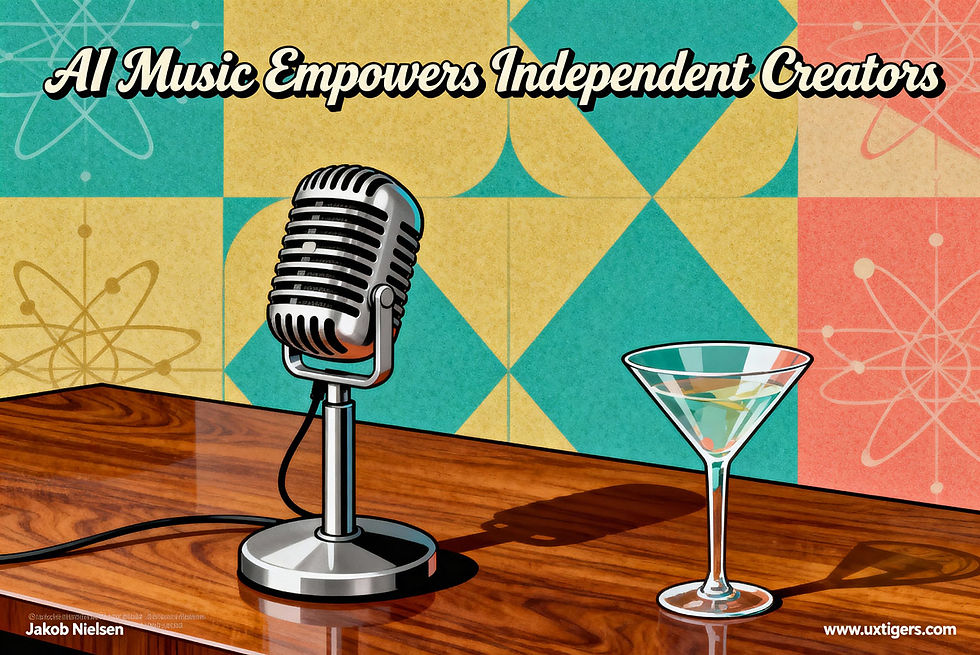
Suno is not just a tool for professional musicians and music publishing giants. It also empowers individual, independent creators to make songs. It’s so fast and easy to make a song with Suno that every birthday party should feature an individualized song about the birthday boy or girl. (Seedream 4)

Parents and children making music, videos, comic strips, and many other content formats together in the family is one of the immense benefits we’re getting from generative AI. (Seedream 4)

A popular Silicon Valley saying is that “you can just do things.” We need to cultivate this sense of agency and empowerment in young people to foster a growth mindset and an internal locus of control (the belief that each person can influence their own circumstances), rather than an external locus of control that believes change always comes from others. Making simple creative works is a great initial activity. (Seedream 4)
Sure enough, almost 100 million people have already made music with Suno. This is an explosion of independent music and individual creativity that’s no longer gated by the need to possess technical skills that require years of training. Music is also no longer gated by the “Big Music” publishing companies, their producers, and established distribution channels. Something that annoys legacy record labels no end and has caused them to file unfounded copyright suits against music-creation AI services in an attempt to preempt the competition from billions of independent songs.

Suno has already empowered 100 million people. I would not be surprised if they surpassed a billion creators in a few years, given the infusion of new investment they just received. (Seedream 4)

The old gatekeepers no longer stand in the way of millions of people making whatever they feel like. This liberation of individuals is one of the biggest benefits from AI, possibly even more important than the doubling of the economy we’ll get. (Seedream 4)
I say “unfounded” copyright claims because AI doesn’t copy or even cover songs from the Big Music catalogs. It has learned from them, yes, but that’s no different from what every musician in the history of the world has done. When Mozart was a child prodigy, he performed music by many earlier composers, from Johann Christian Bach to his own father, Leopold Mozart. Do we think Mozart learned nothing from playing these earlier works? Of course, he did, but learning is not a copyright violation.

Mozart learned from the music of those who came before him. So did we all. How do I know how to write articles and science papers? From having read thousands. (Seedream 4)

By empowering hundreds of millions more people to make new music, Suno is enriching humanity by expanding our heritage. (Seedream 4)
Most of the works people make with Suno are nothing special and won’t be played in a few years. (Among other things, because AI music will get much better, and shortly vastly exceed anything humans can make manually.) However, in totality, this flood of music is valuable for two reasons: first, it includes hyper-targeted songs that are appreciated by narrow audiences (like my own songs), and second, because the laws of eminent intellectual performance say that the more attempts, the more stellar works result, even if most works aren’t great.

As billions of people will be making billions of creations with AI in a few years, most of those creations won’t be that good. However, here and there, there will be a diamond coming from a creator who would never have been heard from without AI. (Seedream 4)

The more precisely targeted the content, the higher its value for the few (maybe just a single individual) in that narrow target audience. (Seedream 4)
Most traditional music artists recorded only one hit in their careers, but that hit was worth having. (The likes of Mozart and The Beatles, who make many eminent works, are the exceptions, not the rule, in the genius business.) Similarly, of the billions of creations made with Suno and other AI tools for independent creators, a few are guaranteed to be wonderful. (The AI-made song “Walk My Walk” was number one on the Billboard country music sales chart for November 2025. Topping the charts once doesn’t necessarily denote a sustained hit, but it’s a milestone. Very appropriate that this first AI hit is about being independent.)

Most “genius” level advances for humanity are created by people who only ever did that one great thing in their lives. But hundreds of people doing one great thing (plus many nice things, of course) is enough for humanity to advance. (Seedream 4)

An AI song about being independent topped Billboard’s hit list in November 2025. (Seedream 4)
If you want to support this useful endeavor, Sono currently has an opening for a product designer. Appropriately, they created a singing version of this job posting, even though the chosen music style is not to my taste.

Suno used its own technology to advertise its product designer position in a song. (Seedream 4)
Inference Compute Shortage
The many recent rollouts of improved AI services have caused a severe shortage of inference compute, across several companies. OpenAI/ChatGPT frequently fails requests, and even mighty Google can’t serve customers.
Google otherwise is supposed to have the advantage in the race toward superintelligence because of its TPU chips (tensor processing units) which are more energy-efficient than the “standard” NVIDIA GPU chips used by all other AI companies outside China.
(Because of the US-led trade blockade, Chinese companies use domestically-made AI chips with even worse energy-efficiency, though this is less of a problem for them since China has wisely been building a fleet of both nuclear power plants and solar energy installations, giving the country more than twice the electricity generation capacity of the United States. Current numbers are China 9.3 PWh, USA 4.2 PWh, European Union 2.9 PWh, but in 2030 when we hope to get superintelligence, China is predicted to generate 13.8 PWh, whereas the US and EU will only grow to 4.5 and 3.1 PWh, respectively. Power plants take time to build, so our future prospects depend on the accelerationism of the last several years, which was extremely low in the US and EU.)
Google’s simultaneous release of both Gemini 3 Pro and Nano Banana Pro last week was enough to break them. Google’s “TPUs are melting,” to repurpose Sam Altman’s memorable characterization of OpenAI’s datacenter overload when it released the ability to convert photos into Studio Ghibli style.
Here are 3 visualizations of Google Cloud I made with Nano Banana Pro, in the styles of “a funny cartoon,” a fantasy illustration, and a photorealistic image:


Nano Banana Pro’s “funny cartoon” is indeed somewhat funny, but not ROTFL worthy. And I don’t like its cartooning style. (It used roughly the same cartooning style across 4 images I generated.)
In general, Nano Banana Pro is a good image model; for example, I used it to make one of the images in the above story on Suno, which I had tried multiple times in vain to make with Seedream 4 (the racing cars made of music and slideshows, respectively). I also used Nano Banana Pro for this week’s posting image. (Two versions: one at the top and one at the bottom of this newsletter.)
Sadly, though, when using Nano Banana Pro on Google’s own platforms (whether Gemini or Flow), it is somewhat heavily censored and politically correct. Luckily, the same image model is more freethinking if accessed on a third-party platform through the API. Currently, I’ve tried on Freepik, Higgsfield, and Leonardo; and Freepik is my favorite because it's less restrictive.
All these outside platforms need to seriously increase the size of their prompt boxes, which typically limit prompts to under 3,000 characters, which is woefully insufficient for a use case like pasting this newsletter (25,000 characters) and asking Nano Banana Pro to make it into an infographic. The raw Nano Banana Pro is perfectly capable of handling very long prompts on Gemini, except that it refuses to draw some elements of the newsletter, which is obnoxious, given that it could simply have designed around these limitations. (For example, it won’t draw famous people, so it won’t make an infographic frame of Satya Nadella giving a datacenter tour, but it could just have replaced him with a generic nerd giving the tour.)

Infographic depicting Satya Nadella as a mastermind giving a data center tour. I doubt he’ll be displeased with this image if he sees my newsletter. (Nano Banana Pro, used via Freepik to avoid censorship)
What a Week!
Originally, I planned this to be a short newsletter, but events got in my way.

I asked Nano Banana Pro to make an infographic summarizing last week. I prompted it to be fair and give equal billing to other labs, but in truth, last week was Google’s.
With Nano Banana Pro, infographics have been automated. One click, and done! However, even though I like the above infographic, in general, I recommend that you use indirect prompting and make your infographics in two steps: first, decide what should be in the infographic, including finetuning the text, and then have the result rendered.


