
UX Roundup: User Research Game | AI Photo Recommendations | AI Helps TA | Teaching Metacognition | AI Shorts | 100 TW Compute | Happy Horse

Summary: User researchers as role-playing game classes | AI posture recommendation feature in Huawei Pura 90 phones | AI helps teaching assistants provide better feedback to students | AI as a metacognitive coach | Recommending an entertaining short AI film | SpaceX’s plan for 100 TW orbital compute | New Chinese video model Happy Horse from Alibaba

UX Roundup for May 4, 2026 (GPT-Images-2)
User Researchers as Role-Playing Game Classes
I continue to play with the new capabilities unlocked by the GPT-Images-2 model’s reasoning abilities and world knowledge. Here are examples of the prompt “draw the class sheet for ‘user researcher’ as a new RPG class.” I specified different subclasses for these class sheets.

The manager. (GPT-Images-2)

Discount usability. (GPT-Images-2)

The insight oracle. (GPT-Images-2)

Diary studies. (GPT-Images-2)

The field ethnographer. (GPT-Images-2)

ResearchOps. (GPT-Images-2)
I made these class sheets for fun, but they can serve a serious purpose for teams that need to introduce themselves and their specialties to stakeholders or colleagues in other disciplines. You can upload your own photo as a reference image and ask for the player to be drawn with your likeness.
I built these across several chat sessions, because it was too much fun to stop, which is why the styles differ across cards. If you build everything within a single session, or if you upload existing cards as a style reference, GPT delivers strong design consistency. (On the other hand, within a session, GPT drew characters that looked too similar, overdoing style consistency.)
AI Posture Recommendation Feature in Huawei Pura 90 Phones
I have often talked about the need for AI features to meet users where they are and to smoothly address a current need, rather than being bolted on for the sake of saying “now AI-enabled.”
The new Huawei Pura 90 phone series provides a good example. Unfortunately, Huawei remains banned in the USA for political reasons, but luckily, we can see the feature demonstrated on X now that it is a fully international social media platform with automated translations. (Which serves as another example of integrated AI.)
Watch this short video posted by Indian user “Noah Cat” of Huawei’s “AI Posture Recommendations” in action. It looks like a promotional video originally produced by Huawei and probably posted to some of the Chinese social media platforms.

Still image from the Huawei demo video. The text by the arm holding the selfie-camera reads “raise your arm” and the text to the right reads “keep smiling,” the latter probably being redundant advice for a selfie. The part of this UI that I really like is the way the outline naturally helps you position yourself in the photo to achieve an engaging composition.
AI Posture Recommendations overlays real-time pose outlines in the camera viewfinder, suggesting scene-tailored positions like raised arms or dynamic stances to improve photo quality on the first try. Sorry to be prejudiced but this does seem like a feature targeted at young people in Asia who really love funny postures for their selfies. (As empirically observed every time I’m in Asia.) However, serving your target audience is good UX.
For my purposes, the question is not whether funny poses in selfies are good or bad. My point is that using AI to analyze how a user could look funnier and then overlaying that posture recommendation directly where he or she is already looking is an AI UI with great usability.
This is a command-free interaction that’s integrated with the task and appears exactly when needed.

No commands: just AI that appears naturally integrated with the task when it’s needed. And fun too, which is what we need to improve public perceptions of AI. (Nano Banana 2)
AI Helps Teaching Assistants Provide Better Feedback to Students
Many studies have already shown that students’ learning suffers when they use AI to do exercises instead of solving the problems on their own. (AI does help students when used as a coach or teacher, to help the students get over stumbling blocks when they are solving problems.)
But what about doing some of the teachers’ work on their behalf? In one study, this did help the students, by providing better feedback on their class assignments.
A research team at the University of Michigan tested an AI system called FeedbackWriter that augmented teaching assistants’ (TAs) feedback on assignments college students. Their randomized controlled trial spanned a computer‑science course with 354 students and 12 teaching assistants. Half of the TAs used the FeedbackWriter tool, which generated draft comments and allowed TAs to edit and approve them; the control group wrote comments manually.
The results were striking. Students whose assignments were graded with AI‑drafted feedback made more substantive revisions and improved the clarity, correctness, and completeness of their essays compared with peers receiving traditional feedback. TAs using the AI found that it encouraged them to provide more balanced feedback, highlighting strengths as well as weaknesses. Importantly, the AI never operated autonomously; human oversight remained central, preventing hallucinations and ensuring alignment with grading rubrics. In post‑study interviews, TAs emphasized that the AI acted as a brainstorming partner. It suggested phrasing for difficult comments and helped them notice patterns across student mistakes. The researchers argue that by embedding AI at the right point in the workflow to support but not supplant human judgment, FeedbackWriter increased both the quality of feedback and instructor satisfaction.
We know that one thing AI is perfect at is to generate word count. It’s no great surprise that the feedback to the students was lengthier when the TA used AI: 284 words vs. 159 words. The AI-augmented feedback also broader, covering 20% of scoring rubrics on average for the AI-augmented feedback and only 16% in the no-AI condition.
Of course, the extra feedback from AI vs. humans-only might have been misleading or overwhelming, but this was not the case, according to the scoring of the final assignments handed in by the students after they had a change to use the TX feedback to improve their drafts.
The quality of the students’ final draft was rated as 29% higher when their TA used AI to generate feedback on their first draft. (The rating between the two drafts increased by 22 points in the AI-augmented condition and only 17 points in the no-AI condition.)
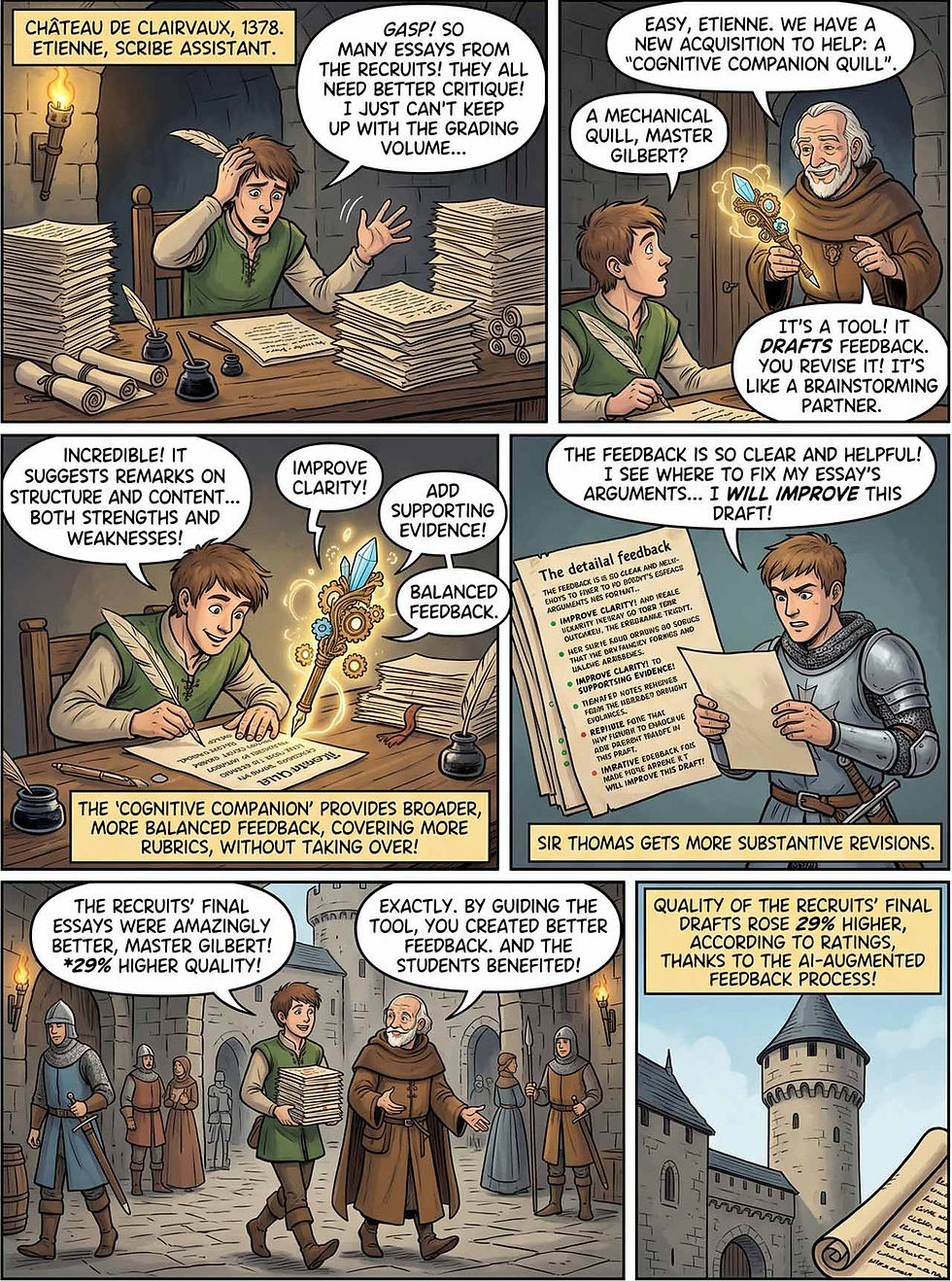
The study was at the University of Michigan, not a medical castle, but this is roughly how it played out. (Nano Banana 2)
AI as a Metacognitive Coach: Curing Cognitive Laziness
There is a pervasive fear in the tech community that artificial intelligence is turning us (and the next generation of students) into lazy thinkers. If Codex can instantly spit out a fully functional Python script or Claude Designer make a high-fidelity UI prototype, won’t we lose our fundamental problem-solving skills? If AI acts as an over-eager intern doing all the grunt work while we merely nod and approve, cognitive atrophy seems inevitable.
But a new randomized controlled trial published in Frontiers in Psychology (April 2026) by Hou et al. from the Luoyang Institute of Science and Technology in China flips this pessimistic assumption on its head. The researchers discovered that when AI is designed correctly, it doesn’t diminish human agency. It actually cures cognitive laziness.
The researchers studied 122 computer science undergraduates learning to program. As UX professionals know, there is a vast gulf between what users say and what they do. In surveys, students consistently claim they know how to plan, check their work, and debug systematically. But faced with a blank screen, they panic and start mashing the keyboard in a frenzy of trial-and-error.
To bridge this awareness–behavior gap, the researchers used a customized programming environment with an integrated autonomous AI agent. The unexpected, brilliant twist? The AI was expressly forbidden from writing a single line of code.
Instead, it acted as a behavioral scaffold. It quietly monitored students’ fine-grained interaction logs for signs of impulsive behavior. If a student opened a complex assignment and instantly started typing, the AI intervened with a lightweight popup: “You started coding very quickly. Have you broken down the problem requirements?” If a student triggered three errors in a row and rapidly changed the code without thinking, the AI would prompt: “Repeated errors detected. Instead of guessing, consider reading the traceback message.”
Slower is Better: The Power of Friction
The results run contrary to the traditional usability dogma that “faster is better.” In this case, good UX meant introducing deliberate cognitive friction. The AI successfully inhibited the novice’s “rush-to-code” impulse. The time students spent planning before their first keystroke quadrupled from 45 seconds to 186 seconds.
Because they paused to plan, their blind guessing plummeted from 36% to just 12%, and students’ debugging success rate soared. They engaged in deeper cognitive struggle than the unassisted students, ultimately achieving significantly higher academic scores. They didn’t thrash; they thought.
The reason slower was better in this study is that the goal of education is to learn, not to get the assignments done as fast as possible.
Findings: How Students’ Behavior Changed
1. Objective Behavioral Shifts (The Log Data): The system didn’t change the quantity of the students' actions: both groups executed their code roughly the same number of times and had similar total debugging counts. But the AI radically improved the quality of those actions.
Enforced Planning: As noted earlier, unassisted students rushed into the task, typing their first line of code in just 45 seconds. The AI-coached group was nudged to slow down, taking an average of 186 seconds before their first edit. They actually stopped to design an architecture, reflected by their comment-to-code ratio jumping from a dismal 3.5% to a robust 15.2%.
Deep Error Diagnosis: When encountering a runtime error, the control group paused for an average of just 6.2 seconds before changing their code, a classic hallmark of frantic novice “thrashing.” The AI group averaged an 18.5-second “error dwell time,” utilizing the pause to actually read the traceback data.
Reduced Blind Guessing: Because they stopped to think, the AI group’s “ineffective trial rate” (blindly tweaking code without understanding the problem) plummeted to 12.4%, compared to an alarming 35.8% in the control group. Consequently, their debugging location accuracy leaped from 61.6% to 72.4%.
2. Superior Academic Outcomes: This deliberate behavioral friction did not hamper their actual learning; it accelerated it. In an independent post-test programming assessment where the AI scaffold was removed to test true learning transfer, the experimental group scored an average of 85.2 out of 100, decisively beating the control group’s 76.5. The researchers found a strong correlation confirming that the deliberate debugging behaviors fostered by the AI directly translated into higher independent academic achievement.
3. Surging Metacognitive Awareness: The intervention also fundamentally altered how students perceived their own cognitive abilities. On a 100-point Metacognitive Awareness Inventory scale, the two groups started with nearly identical baseline scores. However, by the end of the study, the control group had gained only 10.9 points, while the AI-assisted group surged by a massive 33.4 points.
The Superiority of Teaching Metacognitive Behaviors
What the AI taught these students wasn’t Python syntax. It taught metacognitive behaviors: the ability to plan, monitor, and regulate one's own thought processes.
Traditional education still focuses on drilling plain facts and rote skills into students. But by the time today’s university freshmen graduate, AI advances will have rendered their hard-earned skills entirely obsolete. We are rapidly entering the third user-interface paradigm in computing history: intent-based outcome specification. If you can specify the outcome, the AI will execute the skill.
What will not be obsolete is metacognition. Teaching a student the exact syntax of a “for” loop is a fool’s errand; developing the metacognitive discipline to pause, plan, and verify is how you forge a professional who can effectively direct future AI systems.
AI as a Coach
This study perfectly validates my recent article on the 4 Metaphors for Working with AI, where I categorized our interactions into four roles: Intern, Coworker, Teacher, and Coach.
Most educational anxieties stem from the Intern metaphor. When we hand an AI a prompt and it does the work, it completely undermines learning because the AI just solves the problem for the student.
Other systems act as a Teacher, patiently explaining concepts like a personalized tutor. This is the metaphor used with most other uses of AI in education today. Much better! But even this focuses on delivering soon-to-be-obsolete facts.
The educational AI in this study operated strictly under the Coach metaphor. A gymnastics coach doesn’t do the floor routine for you. The coach stands on the sidelines, watches your form, and yells, "Straighten your left leg!" By focusing on the user’s process rather than the product, the AI coach forces the human to do the heavy lifting, but with superior form.
Takeaways for Product Design
For product design strategists, there are two major takeaways here:
1. For your personal career future: Look closely at your daily tasks. If your primary economic value is generating standard deliverables, whether boilerplate code, simple wireframes, or routine usability reports, you are competing with the AI Intern. And the AI Intern works faster and cheaper.
Your future viability relies entirely on elevating your metacognitive skills. You must become the strategist who understands how to plan a multi-phase research initiative, monitor the changing market landscape, and regulate your team's approach. Cultivate your ability to direct the AI, monitor its outputs critically, and adjust your strategy.
2. For your design projects: The tech industry is currently obsessed with the generative AI “magic button” that does all the work with zero effort. But if you design enterprise software, learning systems, or professional UX tools, consider the AI-as-Coach paradigm. How can your AI monitor user behavior to offer non-directive, process-oriented prompts?
Well-designed friction is a core component of human–AI interaction. Sometimes, the best UX doesn’t come from doing the work for the user, but from providing the strategic scaffolding that empowers them to master the work themselves.


I think Socrates might have liked this new approach to using AI to help students learn how to think and solve problems. (GPT-Images-2)
Entertaining AI Short Film
I recommend watching The adventures of Kulrik and Boon part one - Journey to Ashkarn (YouTube, 9 min.), a short fantasy film by Stevie Mac about the adventures of an orc and his trusty giant pig. Watch in 4K!
The film is entertaining in its own right, with everything from exciting vistas to fun moments where the orc interacts with his pig. However, we should recognize that the story only holds up for a short film and would probably not work if expanded into a two-hour feature film. Such is the state of the art in AI-filmmaking this year. Next year? Mid-length episodes, and by 2028 I expect to see full-length movies made with AI that equal the average output of the legacy studios, if not their very best work.
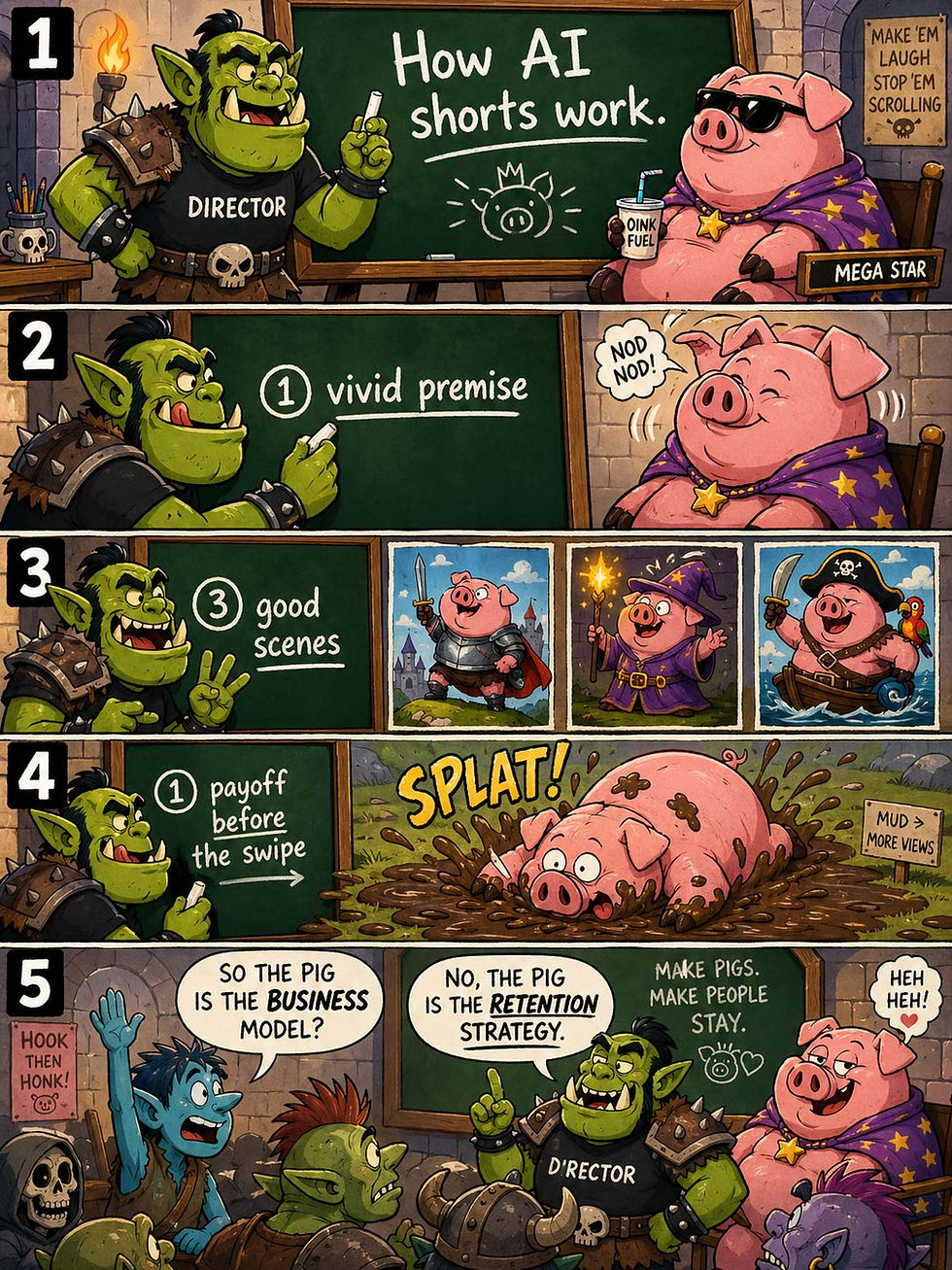
I am already looking forward to the second episode of Kulrik and Boon. Mostly for the pig. (GPT-Images-2)
For now, shorts are the first native media form of AI.
The short film was made with Seedance 2.0, which is the best current AI video model, and almost every scene looks superb. (In one scene, the orc fights a bunch of skeletons that have come alive to defend a treasure, but fighting or not, I don’t think skeletons spout blood when beheaded.)
The broader lesson is that AI changes the production bottleneck. For a century, moving images required capital: cameras, crews, locations, lighting, actors, editors, and coordination. AI video attacks this bottleneck directly. The scarce resource is no longer equipment. It is ideas and storytelling.
China gives us the best early evidence of what happens when this shift meets a vast short-video culture. AI animated shorts have become a mainstream category there, with Douyin alone reporting 76 billion cumulative views across 30,000 of titles. This is the right incubation environment. Short videos reward novelty, speed, and emotional clarity. They punish overbuilding. A creator does not need a perfect cinematic universe. He or she needs one vivid premise, three good scenes, and a payoff before viewers swipe away.
This is why AI video is important for individual creators and small teams. The technology does not merely lower costs; it lowers organizational complexity. A single person can try ten visual directions in the time a team might spend negotiating one. A two-person team can combine writing, art direction, editing, and marketing without a studio hierarchy. The result will not always be good. Most of it will be dreadful, because easier production increases the volume of weak work. But it will also increase the number of experiments.
This matters. Many great media formats begin as cheap, slightly embarrassing experiments: comic strips, radio serials, YouTube channels, podcasts, TikTok sketches. AI shorts are the next such format. They let outsiders make visible what remained trapped in their heads. When production becomes cheap enough, talent no longer needs permission. It only needs distribution, persistence, and judgment. China is showing the world that the small creator, not the big studio, may be the first native author of AI video.

New media forms never live up to the standards of the old gatekeepers. Short videos are a native media form of the AI era and will get better, even as old-school film reviewers and movie directors denigrate them. (GPT-Images-2)
SpaceX to Build 100 TW Orbital Compute
The world is currently suffering a terrible compute famine, delaying the growth of AI and making advanced AI too expensive for many applications. The short-term solution is to build more data centers and more power plants, using any type of generation that can be constructed fast, whether solar, nuclear, or (sadly for global warming) gas-powered turbines.
However, even the most aggressive plans will be insufficient to power superintelligence at the scale we will need to revolutionize the world economy and give everybody higher living standards, better healthcare, and individualized education that actually brings each student to his or her potential. Just imagine running every school in Africa on AI and giving every student an AI tutor that’s many times more powerful than GPT 5.5 Pro at extended thinking.
100x more compute won’t do the job.
That’s why I am happy that SpaceX is thinking big and launching a plan to build 100 TW of orbital compute by 2045. Currently, the biggest AI supercomputer is that company’s Colossus, which is rated at 2 GW of compute. Thus, the new plan calls for 50,000x more compute than the world’s biggest right now.

The plan to build 100 TW of compute, running on solar power in orbit around the Earth. (GPT-Images’2)
The plan for orbital compute is included in a new stock incentive plan for SpaceX founder Elon Musk. If the company achieves this audacious goal, he’ll be rich. (Well, he’s already rich, but if he can do it, he will deserve to be even richer.)
Will SpaceX succeed? We’ll have to check back in 19 years, but since Elon Musk is notorious for overly optimistic time schedules, there’s a risk they will be late. However, the exact date doesn’t matter that much to me: what’s important is that somebody is starting a plan to build the vastly larger amount of compute we will need to bring humanity to the next level. This goal will indeed take time, whether 19 or 25 years, which is exactly why we should start now.
New Video Model Happy Horse from Alibaba
China continues to lead in AI video models, with Alibaba’s new Happy Horse model scoring high on the leaderboards and getting rave reviews by many AI creators.

Alibaba’s Happy Horse is having a soft launch at the moment, with availability on some of the API-based creator services, like Magnific and Topview. (GPT-Images-2)
In my limited experimentation, I have been impressed with Happy Horse, and I would rank it just below ByteDance’s Seedream 2.0 and a smidgen above Kuaishou’s Kling 3. This means that the best American video model, Google’s Veo 3.1 is currently out of medal contention.
Happy Horse does well in cinematic scene composition, multi-shot sequences, and lip synch and speech generation. However, when I made a test cut with a snooty English butler and explicitly specified a posh British accent, the butler ended up talking in a distinctly American accent. A small fail, and Happy Horse also had slightly awkward timing in cutting between two camera angles while the butler was saying his lines. (However, Kling often gives me terrible speech generation in English, so I do rank Happy Horse higher than Kling, even if Kling probably has better multi-shots. As always in creative AI, the choice of model should depend on your creative vision. Also Kling generates native 4K video as the only one of the leading video models, so if you need the highest resolution, Kling is the place.)

Happy Horse didn’t make my butler sufficiently English. (GPT-Images-2)
As an aside, I’m happy that we’re finally getting memorable names for AI models rather than just obscure abbreviations (looking at you, ChatGPT) with arcane version numbers (also looking at you, ChatGPT, where o3 was more powerful than 4o — though OpenAI seems to have fixed its numbering scheme as of lately).


