
UX Roundup: Empowering Users Again | Marketese | Impulse Buying | Human Factors Hero | Chinese Prompts

Summary: Reviving the UX goal of empowering users | Writing in marketese kills marketing | Supposed impulse buying is often the result of months of building consideration | Honoring a human factors pioneer, Dr. John D. Gould of IBM | Prompting tip for small text fields: use Chinese
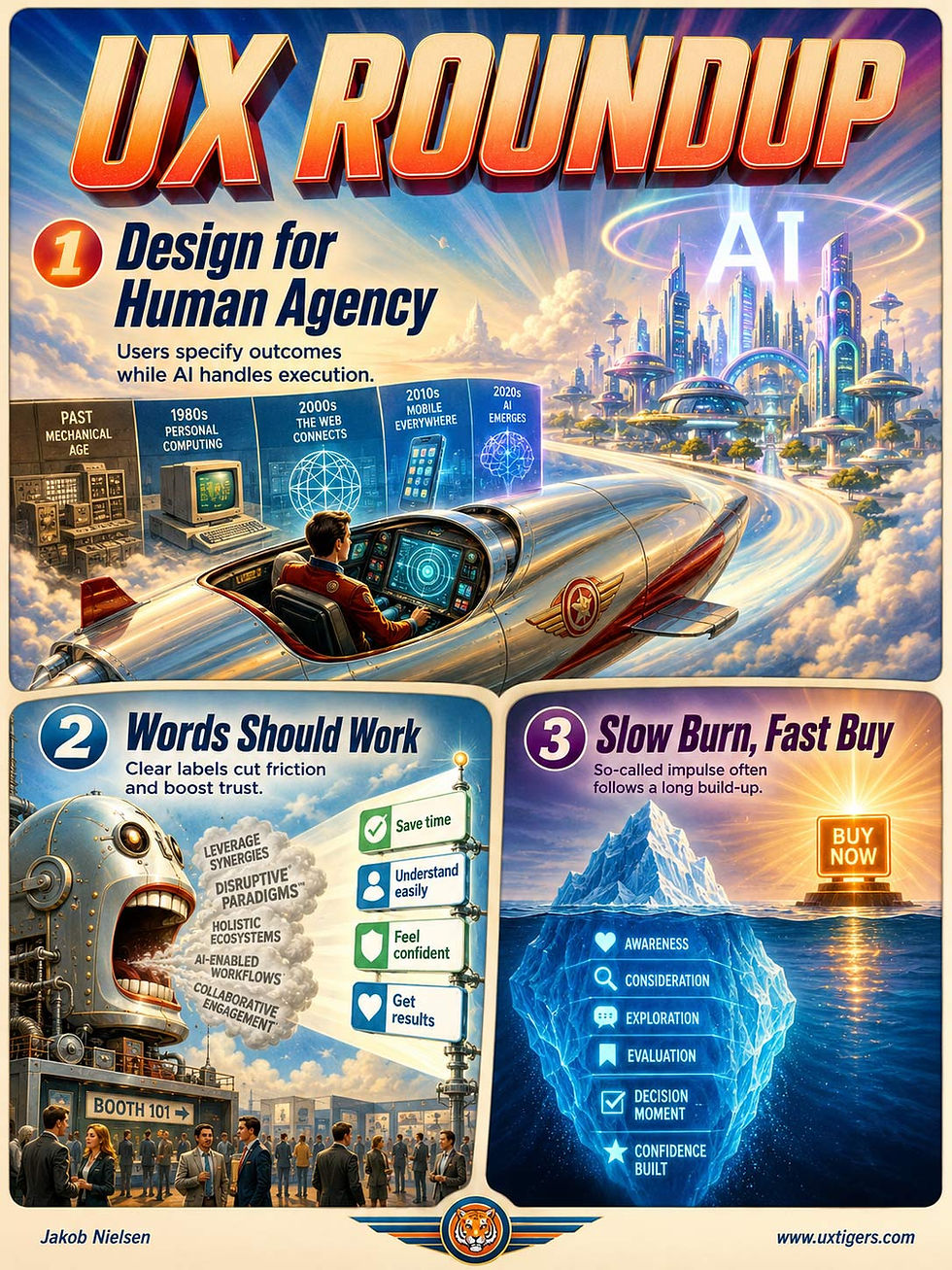
UX Roundup for June 8, 2026 (GPT-Images-2)
Empowering Users Again
AI revives the hope that computers can be empowering for humanity and encourage agency rather than dulling users into doomscrolling.
Over my four decades of analyzing how humans interact with computers, my assessment of technology’s fundamental impact on human beings has certainly not been static. If you were to chart my optimism regarding technology’s ultimate benefit to humanity, the graph would look remarkably like a U-curve: extraordinarily high during the early days of the Web, plunging into a deep trough of sadness during the social media decade, and now, finally, surging upward again with the meteoric rise of artificial intelligence. To understand where user experience is heading, let’s examine these three distinct eras, observing how the fundamental goal of digital design has shifted dramatically over the decades, reflecting our changing relationship with the machines we build.
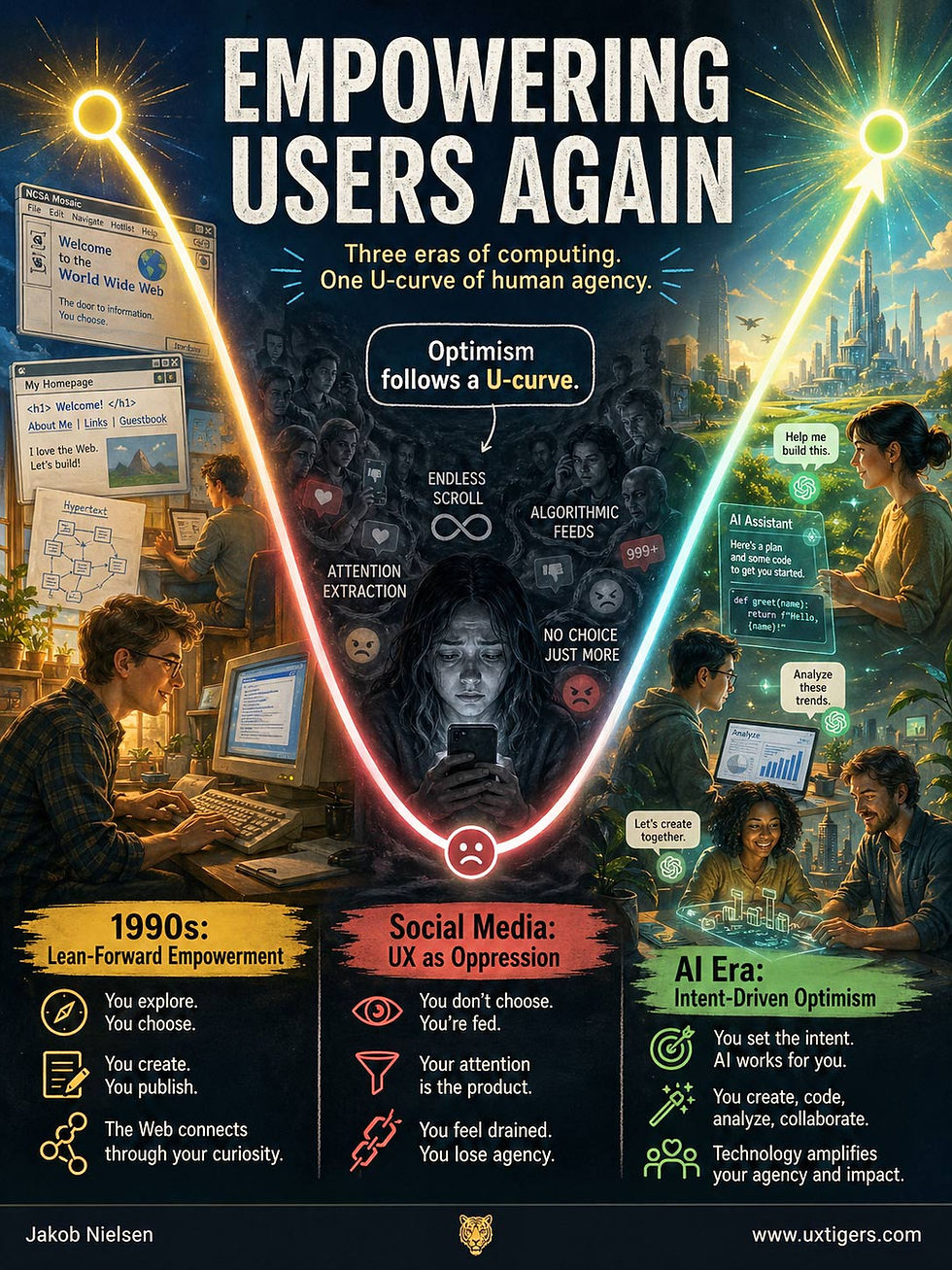
My level of optimism and happyness about UX has been a distinct roller-coaster since the early 1990s. Now its back up! (GPT-Images-2)
The 1990s: Lean-Forward Empowerment
When I pioneered web usability in the 1990s I was very optimistic that the Web would be a lean-forward user experience that empowered users to move around and actively accomplish their goals and also create their own web presence. For decades prior, the dominant technological paradigm had been the television: a fundamentally “lean-back” experience where you passively consumed whatever broadcast executives decided to feed you. The early Web, by stark contrast, required cognitive engagement. It was an active medium. You had to sit up, lean in, and make conscious choices. Users were not mere couch potatoes; they were navigators of complex information architectures. By clicking hypertext links, users actively forged their own unique paths. Our overarching goal in those early days of usability engineering was to remove friction so human agency could seamlessly thrive. From hand-coded HTML pages to early blogs, technology profoundly expanded self-expression. The user was firmly in the driver's seat.
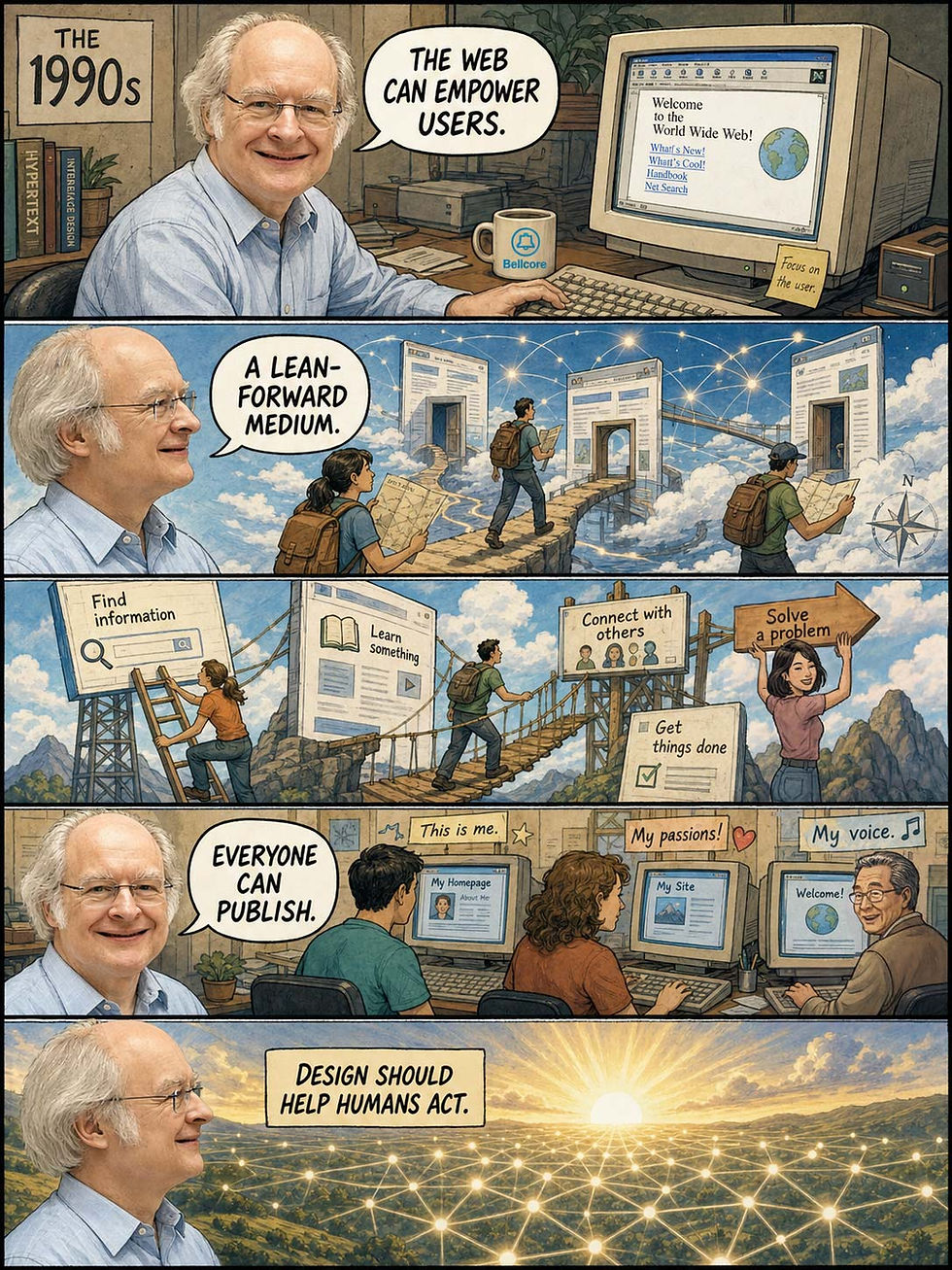
I was so optimistic during the dot-com bubble: we were building a new medium to put users in the driver’s seat. (GPT-Images-2 — when drawing this comic strip, it didn’t realize that I had more hair in the 1990s.)
The Social Media Era: UX as Oppression
Then came the Web 2.0 revolution, which upended this dynamic. Then during the social media era I have been sad that the goal of user experience design has shifted from empowering users to essentially oppressing them by addicting them to infinitely scrolling social media feeds and other passive ways of using computers mainly for consumption rather than creation. Over the past fifteen years, I watched with profound dismay as the Web-design field I helped establish was aggressively co-opted. The primary goal of the tech industry underwent a hostile mutation. Instead of helping users accomplish tasks efficiently, the design objective became capturing and monetizing human attention.
Through psychological manipulation and the deliberate removal of natural stopping cues, tech giants hooked billions of users. The vibrant, lean-forward empowerment of the early Web was tragically replaced by a dystopian reversion to the lean-back experience. Users were conditioned to scroll mindlessly, consuming an algorithmic feed rather than engaging in active problem-solving. Success was no longer measured by my classic usability goals such as how quickly a user could achieve a goal, but by “engagement” (a polite euphemism for addiction). UX design became fully complicit in turning users into captive audiences.
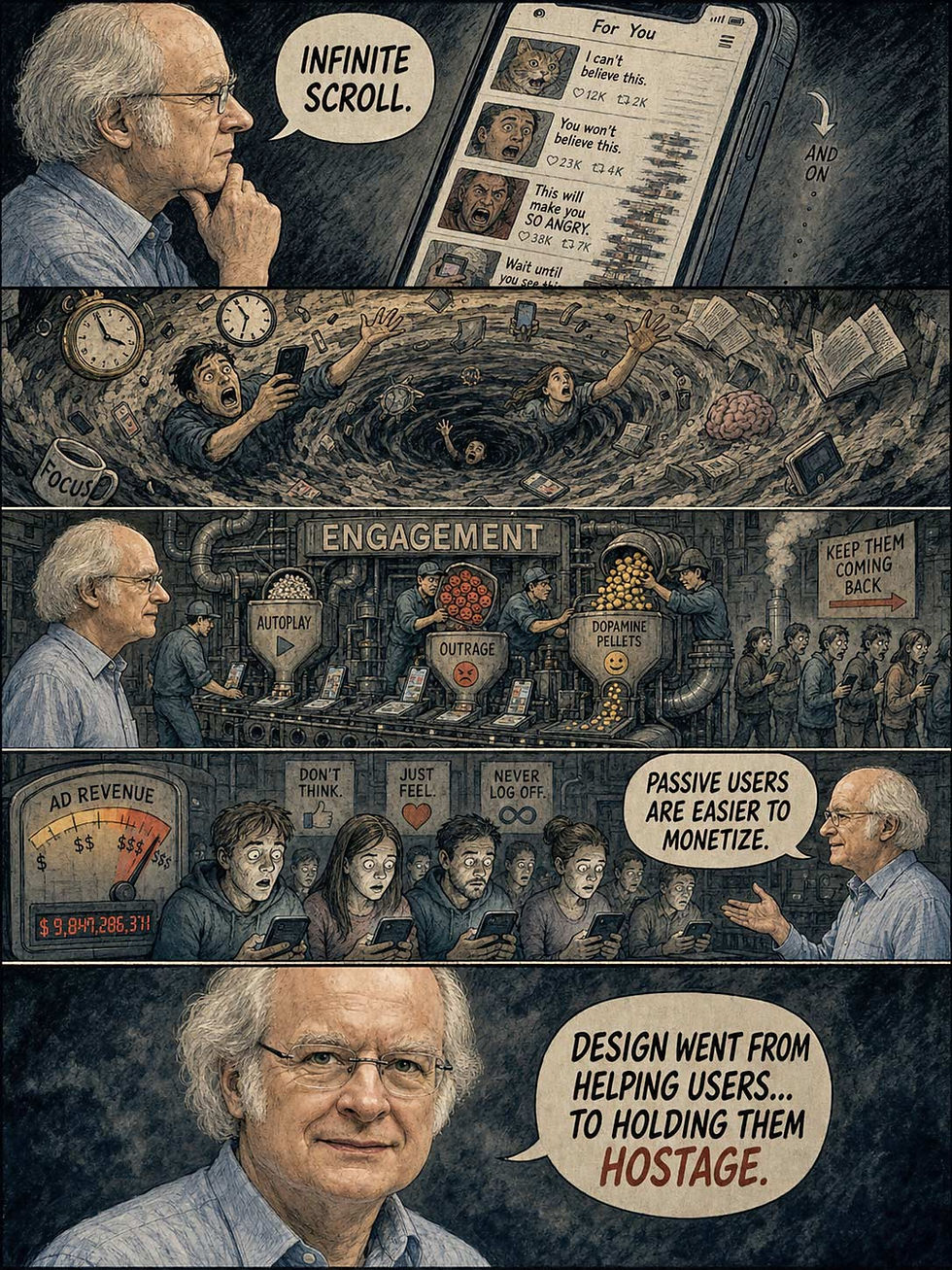
From roughly 2009 to 2022, the main goal of UX in web design was to monetize users, not to help them. (GPT-Images-2)
The AI Era: Intent-Driven Optimism
Today, the fundamental interaction paradigm is shifting once again. Now, I have become an optimist again, with AI use emphasizing creativity, user empowerment and agency, returning to a lean-forward user experience, since AI UX is intent-driven outcome specification. AI represents the first entirely new user interface paradigm since the graphical user interface (GUI) was invented over sixty years ago. We are finally breaking free from the oppressive endless scroll.

Users were trapped. AI can help them break free. (GPT-Images-2)
The core interaction model is fundamentally different from both the traditional GUI and the algorithmic social feed. For decades, users had to tell the computer exactly how to do something, step-by-step. Now, the user simply tells the computer what they want to achieve. The user dictates the intent and specifies the outcome; the AI handles the intricate execution. This model radically re-centers human control. To use generative AI effectively, you cannot be a passive consumer. You must think deeply, articulate a clear goal, prompt the system, and iteratively refine the output. AI tools grant the average user the agency to generate sophisticated text, write complex code, and seamlessly analyze massive datasets.
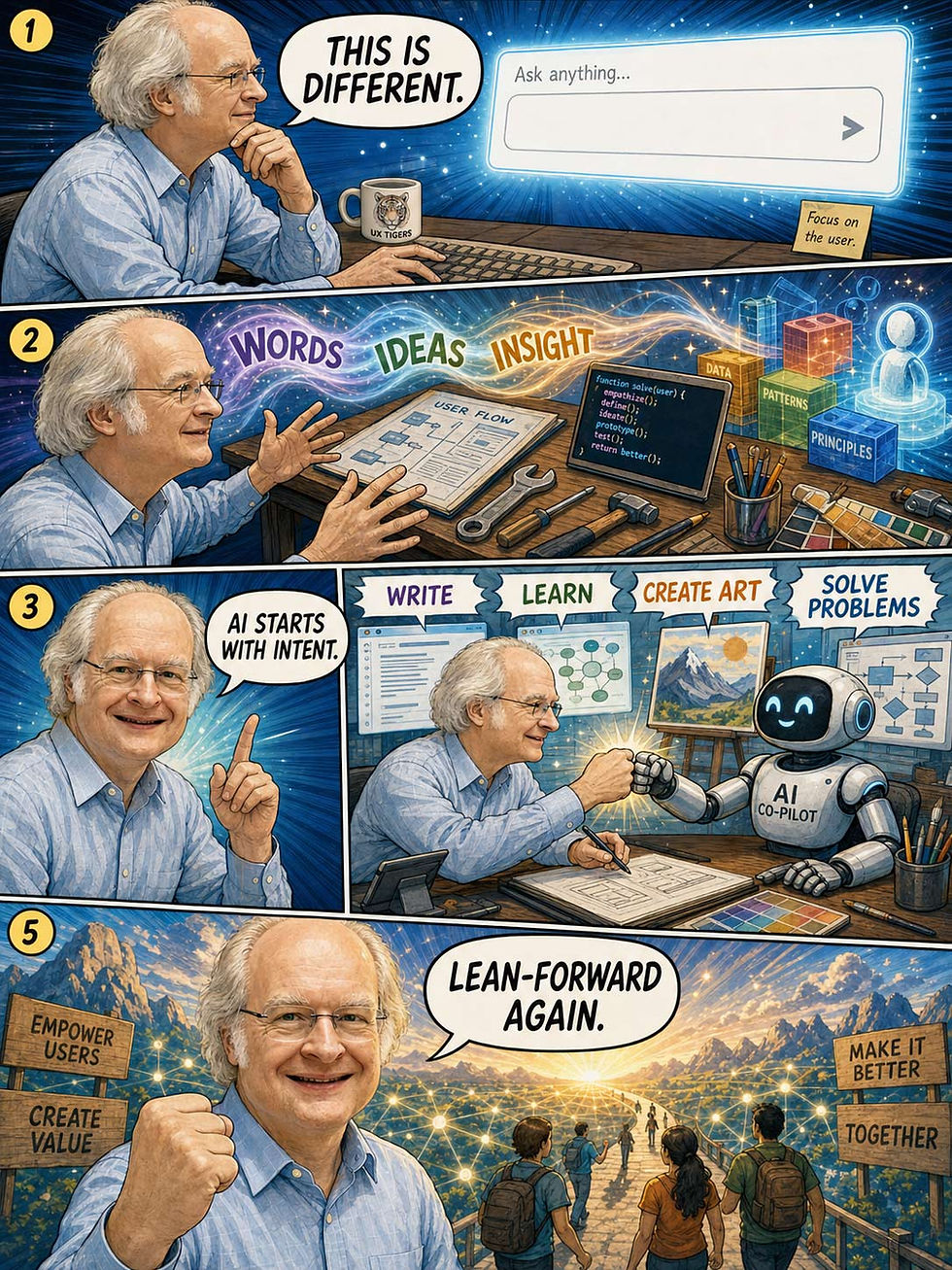
With AI, the design goal returns to empowering users and supporting agency and creation. I am happy again and no longer burned out. (GPT-Images-2)
A New Mandate: Augmenting Human Existence
As we navigate this third era of human-computer interaction, our goals as UX professionals must radically evolve. We must definitively turn our backs on the cynical, attention-harvesting metrics of the previous decade. Our new goal for UX is no longer just selling more and showing more ads (or even the old goal of making office workers more productive), it is becoming to augment human existence through AI.
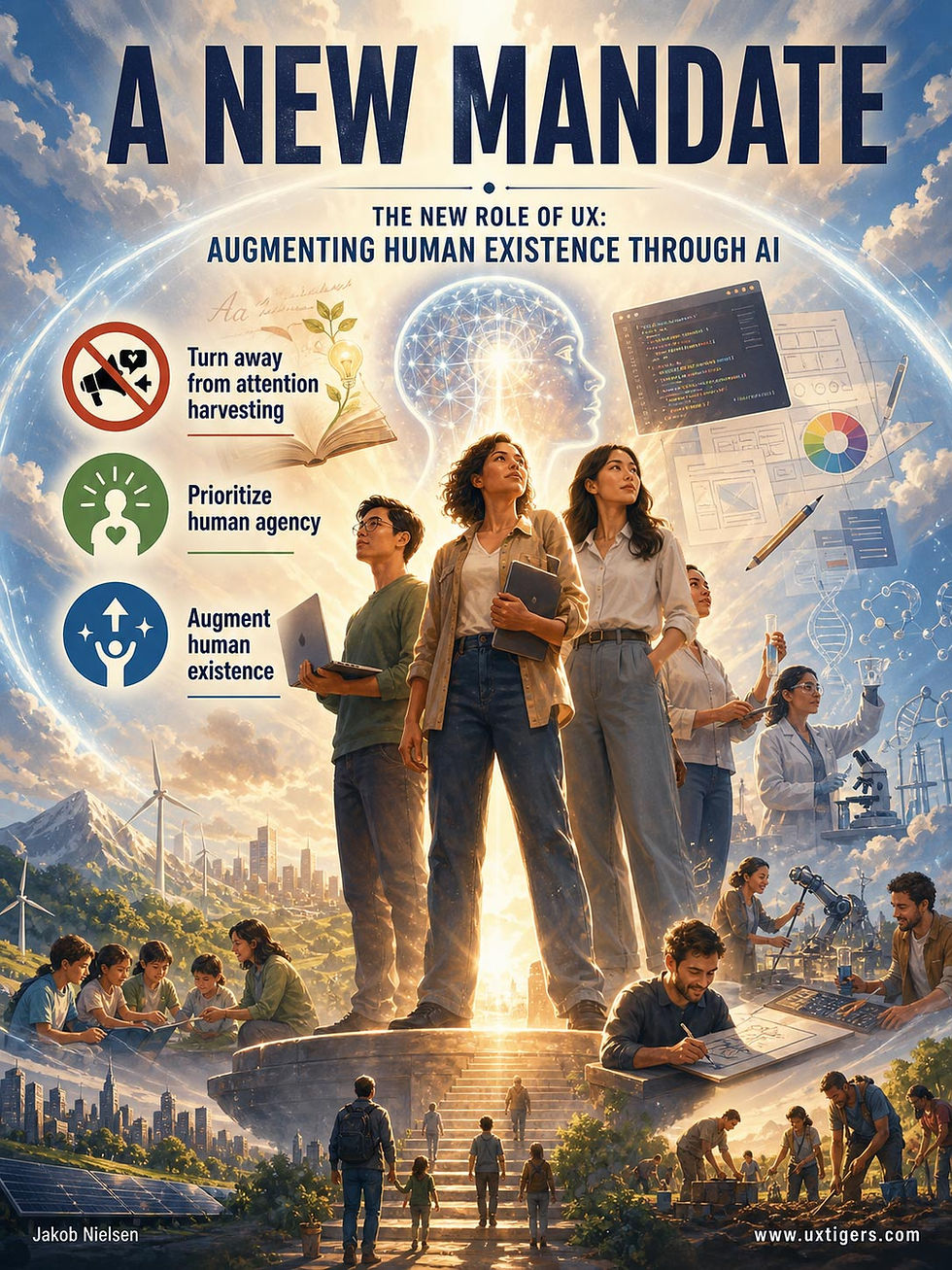
Our new mandate: augment human existence. AI can do this, if we make it so. (GPT-Images-2)
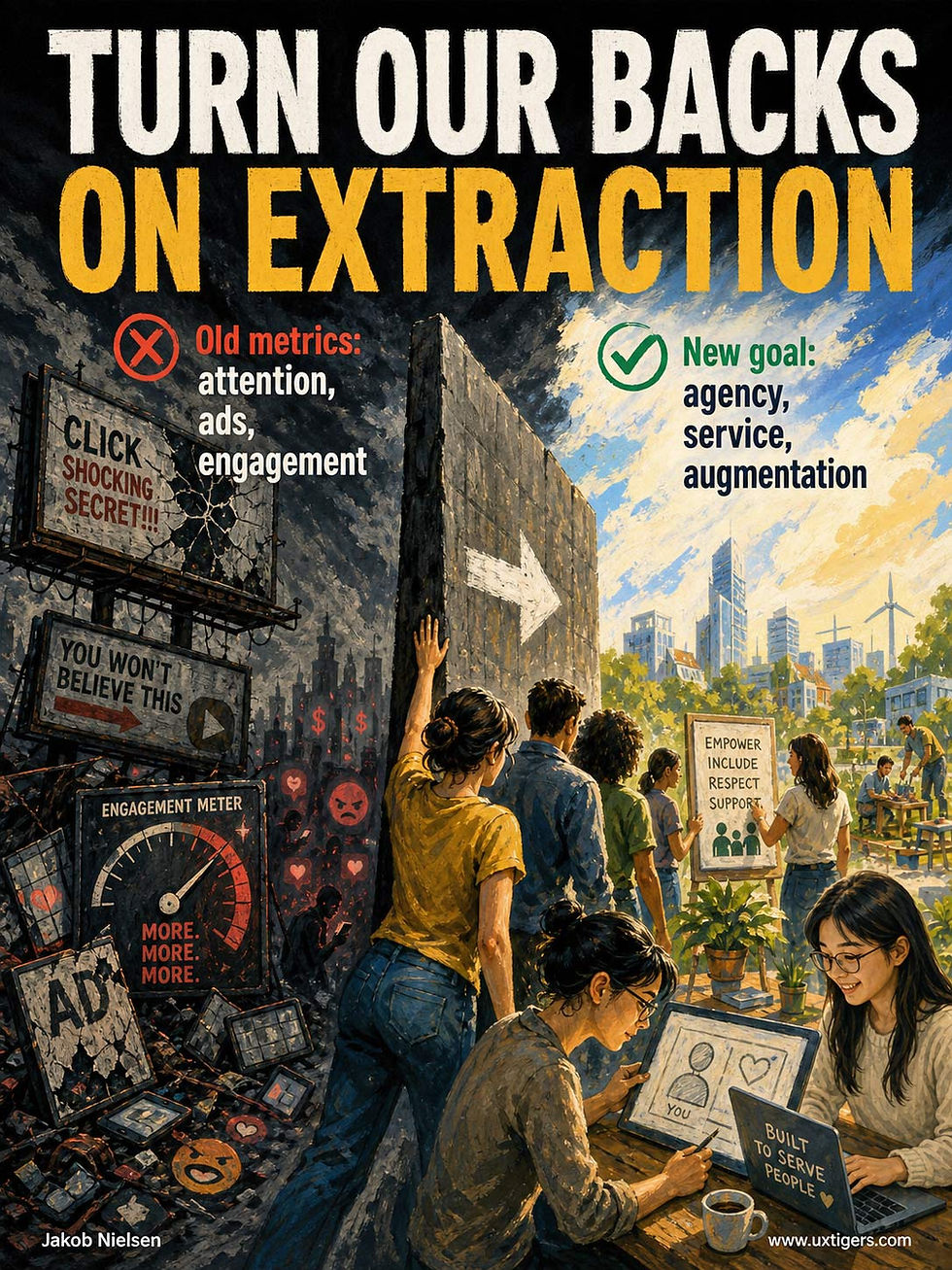
To reach the new world, we must turn our backs to the old metrics that measured attention and treated wasted user time as a positive goal. New UX metrics include time to first creation, breadth of latent-space exploration, and quality of results. (GPT-Images-2)
By embracing intent-driven design and prioritizing human agency, we have an unprecedented opportunity to fulfill the true promise of computing. We are no longer building usable software merely to trap human eyeballs; we are building a vastly more capable humanity. The dark days of digital oppression are fading away rapidly, and a brilliant new era of creative user agency has finally arrived. We must seize this historic opportunity to design systems that truly serve the user.
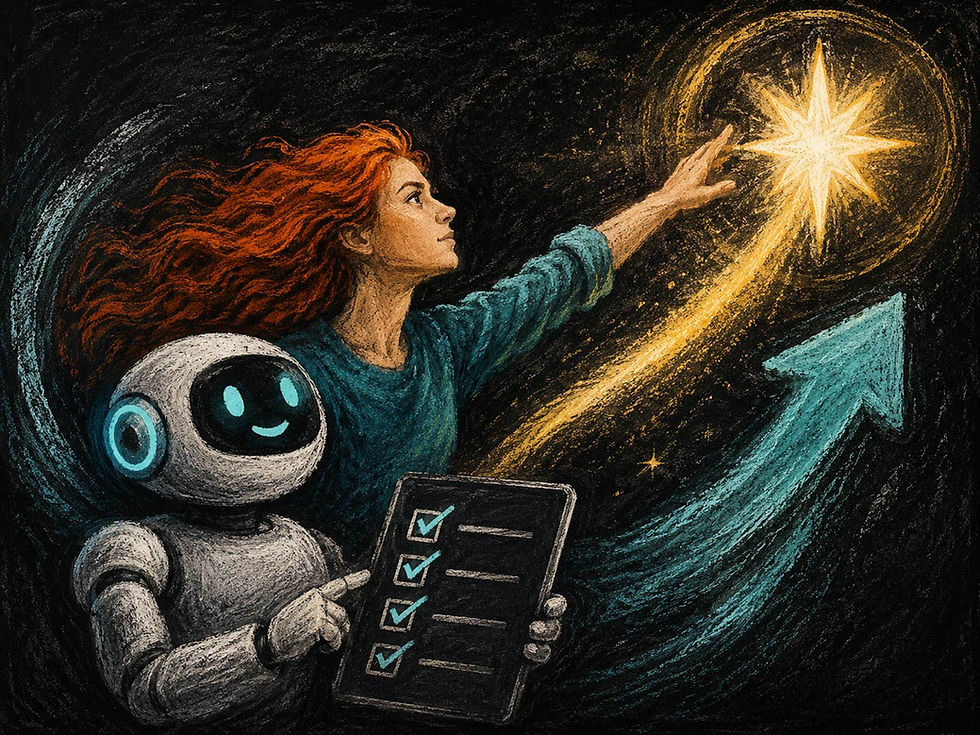
AI helps humans reach their goals, and also helps us set more ambitious goals unlocked by our expanding capabilities. (GPT-Images-2)
Marketese Kills Marketing
In the eternal battle between user experience and marketing, one of the most persistent enemies of usability is marketese: the inflated, boastful, and meaningless corporate jargon infesting homepages, product descriptions, and user interfaces. While irritating in consumer products, this phenomenon reaches catastrophic levels in B2B enterprise software, where the buyers writing the checks are often completely disconnected from the actual end-users who must suffer through the interface.
(GPT-Images-2)
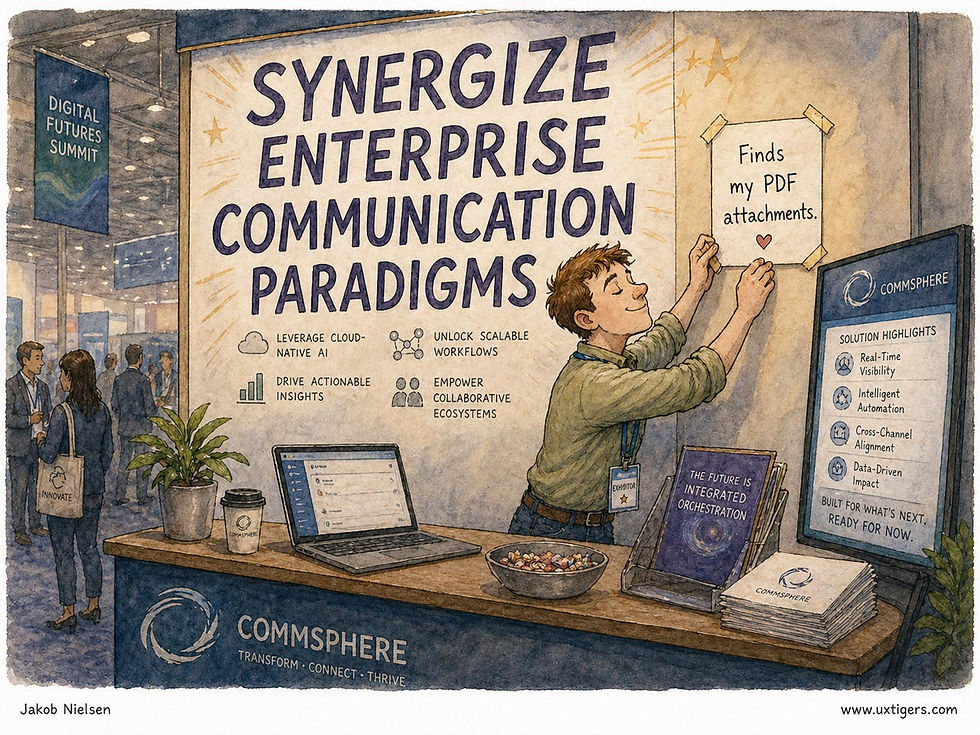
Look at the trade show booth in my illustration. The massive backdrop banner screams, “SYNERGIZE ENTERPRISE COMMUNICATION PARADIGMS.” Below it, bullet points promise to “Leverage cloud-native AI,” “Unlock scalable workflows,” and “Drive actionable insights.” To a Chief Marketing Officer or other executives in your company, this might sound like a visionary strategy. To a user just trying to get their work done, it is an impenetrable wall of cognitive friction.
Decades of empirical eye-tracking research prove users do not read on the web; they scan. Arriving at your interface, they engage in information foraging. They ruthlessly sweep their eyes across the screen, hunting for information scent in the form of specific, plain-language keywords matching their immediate goals.
Marketese actively destroys this information scent. Corporate jargon is invisible to a scanning eye. Labeling a navigation module “Empower Collaborative Ecosystems” instead of simply “Document Sharing” forces users to stop, translate the corporate gobbledygook into human English, and gamble on whether clicking will help them. This needlessly increases cognitive load. Every microsecond spent deciphering terminology is wasted interaction cost. When interaction costs get too high, task success plummets and users abandon the system.
Furthermore, marketese actively degrades user trust. When people encounter paragraphs bloated with buzzwords, their defense mechanisms kick in. They correctly assume the vendor is attempting to hide a lack of real utility behind a smokescreen of multi-syllabic words. Trust is the fundamental currency of the web, and exaggerated claims offering no specific information bankrupt it quickly.
Even worse is the modern tendency for companies to invent made-up words to sound innovative. Let me be blunt: your software interface is not the place to pioneer new vocabulary. Inventing words to describe standard features violates a fundamental usability heuristic: consistency.
Remember Jakob’s Law of the Internet User Experience: users spend most of their time on other websites. Consequently, they have formed entrenched mental models for how things work and what they are called. If the rest of the world calls it a “Dashboard,” do not call it a “Command Sphere.” If standard convention dictates “Settings,” do not label it a “Configuration Matrix.” Forcing users to learn a proprietary vocabulary just to navigate your interface is an arrogant design choice that inevitably degrades your usability metrics.
The antidote to inflated marketese is plain language. You must write exactly what the feature does, using the simplest, most direct words possible. Plain language is not about “dumbing down” your interface; it is about respecting the user's precious time. It benefits everyone, from highly educated domain experts scanning rapidly under pressure, to non-native speakers relying on standard vocabulary.
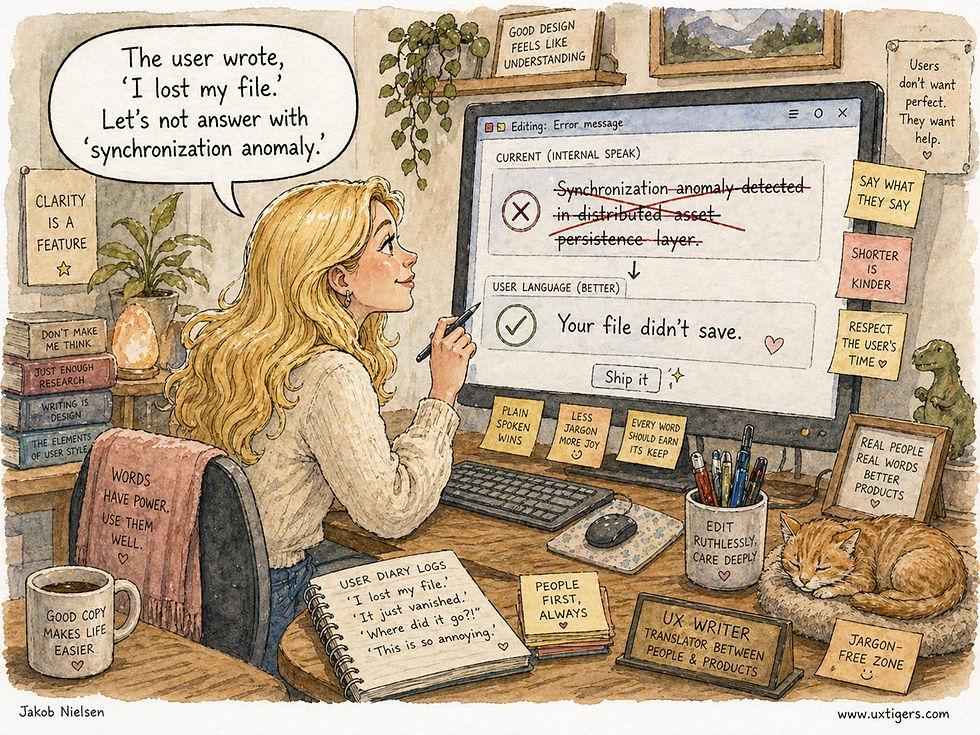
Plain language sells. Plain language makes systems easier to use. In UX writing, collect the vocabulary naturally used by your users and echo it back to them in anything from command names to product descriptions. (GPT-Images-2)
The essence of user-centered copywriting is to ignore the underlying technology (“cloud-native AI”) and the grandiose business vision (“integrated orchestration”). Instead, focus 100 percent on the concrete user benefit.
Users do not care about your company’s paradigms. They do not care about your scalable workflows. They care about themselves. They care about saving time, avoiding frustration, and completing daily tasks. Finding a missing PDF attachment from a chaotic email thread is a real, tangible problem that a human being experiences on a Tuesday afternoon. Synergizing a paradigm is not.
As UX professionals, we must ruthlessly edit our interfaces to remove marketese and firmly push back against stakeholders trying to inflate the UI with marketing fluff. Clarity is your greatest tool. Speak to users in their own language. Describe the real-world benefits of your system in terms they actually care about. If your software finds PDF attachments, just say so. Your users will thank you, and your task completion rates will prove it.
Impulses Are Anything But
Market research firm GWI’s recent Connecting the Dots 2026 report presents a counter-intuitive analysis of impulse buying. In fact, we should place scare quotes around the word “impulse,” because it turns out that many impulses have been building over time.
Ecommerce UX has operated on a strict dichotomy: users meticulously plan big-ticket purchases through long funnels, while buying cheap items on a spontaneous whim.
GWI’s consumer data shatters this binary. Consumers are increasingly making so-called “impulsive” purchases in complex, high-stakes categories like consumer tech (1 in 5 users) and travel (1 in 10). But here is the total-experience reality: this isn’t a random whim. It is the sudden activation of latent intent. Users build consideration quietly in the background. Once they reach a tipping point of confidence, they act instantly.
We should stop separating interfaces into “quick buy” gimmicks and laborious “research” funnels. Treat users as if they are constantly in the market. Provide immediate validation and zero-friction conversions, even for highly expensive items.
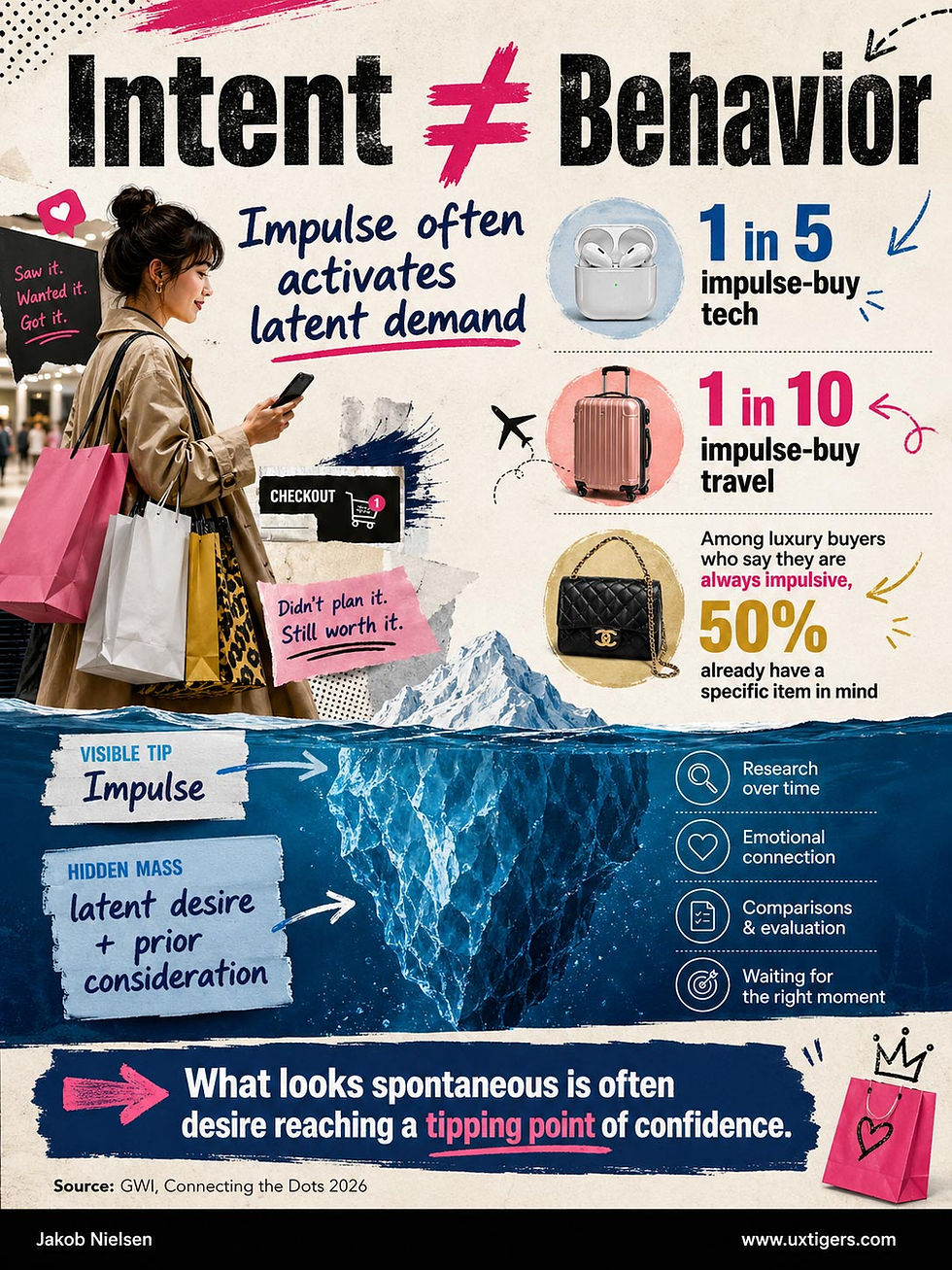
Impulse buying has often been growing for months, and half of buyers already have a specific item in mind when they are hit by the supposed “impulse” to buy. (GPT-Images-2)
I can testify to this from recent personal experience. For months, I have been thinking about running local AI models, and whether to upgrade my computer with the required expensive GPU. Then one day, bang, go to eBay, search, click “buy now.” eBay’s analytics would classify this purchase as highly impulsive, but they are only seeing the tip of my iceberg.
Heroes of Human Factors: John D. Gould
Last week, I ran an infographic portrait of one of my heroes, Professor Ben Shneiderman who has had an illustrative career that started long before the web but also continued into the modern era, meaning that there’s endless information about him online.
For this week’s hero portrait, I decided to give GPT more of a challenge, so I picked John D. Gould who was one of my early mentors, both when I worked with him at IBM’s research headquarters in Yorktown Heights and later. Because IBM stupidly gave a buyout offer that enticed their best staff to retire early, John retired before the web became big, so there’s not as much information about him online, even though he had a prolific research career that included a disproportionately large share of the most important early work on the human factors of computer systems.
GPT did well, and found all the relevant information to create a great infographic about John Gould. With the one glaring exception that the portrait shows a different person who doesn’t look anything like him.
Luckily, since John was a friend of mine, I know how he looked, so I rejected this infographic. I decided to help out GPT by uploading a reference photo with Gould’s true likeness, but I could only find a single black-and-white photo on the entire Web. I had the image model colorize this photo which it did nicely.
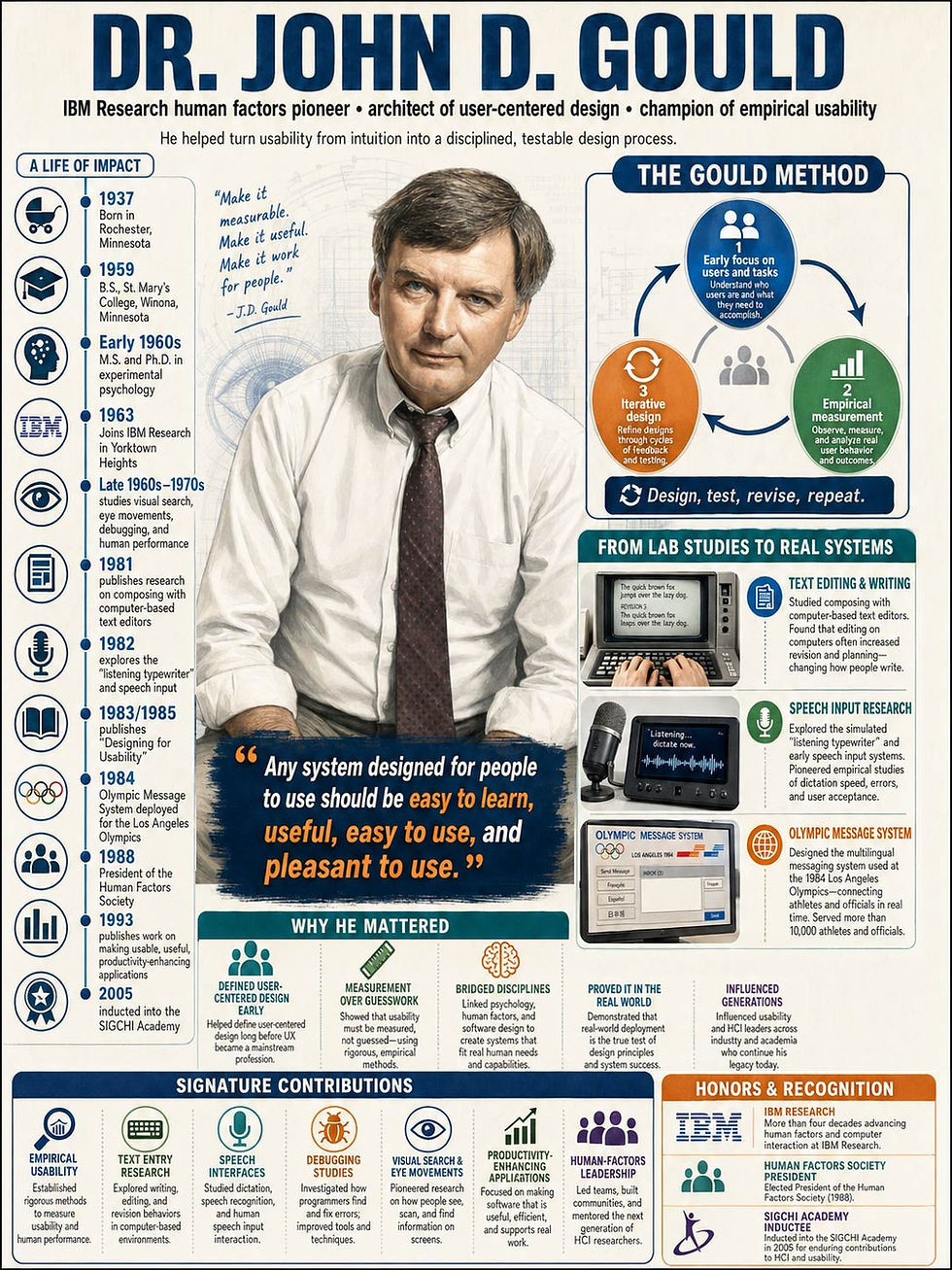
My hero and mentor: John D. Gould, Ph.D. (GPT-Images-2)
Small Prompt Box? Use Chinese!
Tip of the day, courtesy of Theoretically Media: Sometimes a prompt field is too small for the amount of detail you want to include. This is especially true when using advanced video models like Seedance 2 with its multi-shot capabilities. Many of the aggregator services that offer many AI models in one subscription have laughably small text fields for the prompts, sometimes as little as 1,500 or 3,000 characters.
Luckily, since these prompt fields are usually defined with a character count, you can stuff more information into a small field by writing it in Chinese, which has much higher density than European languages in terms of how much information is conveyed per character.
If you don’t write Chinese, use a Chinese AI model like DeepSeek to translate your prompt. (American AI models also translate well, but when I have asked my Chinese friends to rate the quality of my translations of video subtitles, they tend to prefer translations made with Chinese models. Makes sense that a Chinese model would be better at writing Chinese.)
Here is a small example, where a statement needs 119 characters in English, but only 35 characters in Chinese:

(GPT-Images-2)


