
Hamlet Remixed: Using AI to Convert Content into Alternative Formats

Summary: AI can translate a single source across media, styles, and audience frames. That makes it possible to reuse core material in formats better suited to different platforms and audiences. Shakespeare’s Hamlet serves here as a case study in a wide range of AI media transformations.

Thinking about AI as a media form is to recognize that it’s not a single media form, but rather all of them. AI enables creators to transform any content from one media type into another. An article becomes a comic strip becomes a training video becomes a song. All in a few minutes’ work.
To showcase this AI-native content thinking, I decided on a case study of a single piece of content made into many other formats: William Shakespeare’s classic play Hamlet, Prince of Denmark.
This case study remixes Hamlet along three separate axes. Sometimes the medium changes while the story stays mostly intact, as in the comic or music video. Sometimes the style or setting changes, as in the Viking adaptation or Skaldic poem. Sometimes the intended audience changes, as in the tourist posters, tabloids, law review, or consultant decks. AI makes all three kinds of transformation cheap enough that the limiting factor becomes editorial judgment rather than production cost.
Hamlet is probably one of the top three works of world literature, together with Homer’s The Iliad and Lady Murasaki’s Tale of Genji. You likely know the story already, but for a refresher, I recommend reading my 21-page comic Hamlet: The Comic Book. Since this is a long comic, I published it as a separate web page, rather than including it in this article.
Hamlet hardly needs introduction, but if you want a refresher, I recommend my 21-page comic Hamlet: The Comic Book, which I published separately because of its length. (That article also includes a behind-the-scenes account of the workflow.)
At 21 pages, it is my most ambitious comic yet, surpassing my 18-page comic on the history of graphical user interfaces.
Hamlet is a particularly good stress test for AI media transformation. It has a plot many readers already know, sharply differentiated characters, memorable lines, strong visual scenes, and enough ambiguity to support tragedy, parody, analysis, and pastiche. In other words, it remains recognizable even when compressed, relocated, or stylistically bent.
Film
Maybe the most obvious media format for transforming a theatrical play is a film. However, I didn’t make one since there are already many good movie adaptations of Hamlet, including classics starring great actors like Sir Lawrence Olivier, whom we will not be able to surpass with AI for another two to three years.
You can watch the AI short video version I made of another Shakespeare play, Pericles, Prince of Tyre (YouTube, 3 min.), to see what’s possible with almost-current AI video models. I made the Pericles movie almost 8 months ago with Veo 3.0, and I could probably do somewhat better today with Seedance 2.0, which (a) offers 15-second clips instead of 8 seconds, and also (b) allows better direction of multi-shot sequences with an omni-reference model.
Viking Comic Book
The 21-page comic plays Hamlet straight: Renaissance Denmark, circa 1601, staged at Elsinore Castle. Since Elsinore is usually identified with Kronborg Castle in Helsingør, Denmark, I used Kronborg as the model for my sets.
But AI doesn’t require you to convert content literally, or according to tradition. We can morph it as we please.
To make this point, I also created a short 5-page comic strip set in Viking-era Denmark. Shakespeare copied his plot from the legend of the Viking Prince Amleth in the medieval Danish author Saxo Grammaticus’s book Gesta Danorum (the Vita Amlethi episodes), which include all the key elements, such as a prince’s father murdered by his brother, who then marries the widowed queen; prince feigns madness to survive; is sent to Britain with a death order he reverses; returns to kill the usurping uncle. As Steve Jobs said, great artists steal. Shakespeare’s story is more elaborate than Saxo’s, but I do find it appropriate to set this comic strip in Viking Denmark, to honor the original.
Every medium preserves some things and discards others. Comics are good at staging and facial expression. Poetry compresses motive into image and sound. Data visualization reveals structure while sacrificing emotional nuance. Posters and magazine covers thrive by reducing the material to one sharp angle. That is why media transformation is not just repackaging. It is a way of discovering what a source text can survive, and what each medium makes newly visible.


Poetry
Continuing on the Viking theme, let’s transform Shakespeare into Skaldic poetry:
The Drápa of the Dane-Prince
1. The Ghost’s Tale
Grim the ghost of gloaming Greets the heir of Denmark. “Snake-tooth slew the sleeper, Stole the seat of rulers. Brother-bane has broken Bone-house of the king-lord. Hate-full hero, hear me: Hew the hand of murder!”
2. The Rat and the Trap
Madness masks the mind-wolf, Mirthless game is plotted. Rat in room of rushes Reaps the reed-of-battle. Caller of the conscience Catching king in play-act; Fly to foreign far-lands, Fear the foe is waiting.
3. The Sword-Storm
Willow-wife of waters Wanders to the drowning. Cup of curse is carried, Cold the queen has drunk it. Venom vexed the victor, Vengeance strikes the slayer. Spear-storm ends the story, Silence takes the princes.
I used Gemini 3 Pro Deep Think for this poem. Gemini aimed to mimic dróttkvætt, the court meter of Icelandic skalds such as Egill Skallagrímsson, adapted here for English. The key constraints are these:
Syllable Count: Every line has exactly six syllables (e.g., Grim the ghost of gloam-ing).
Trochaic Rhythm: The lines generally end with a trochee (a stressed syllable followed by an unstressed one), creating a falling rhythm distinct to the style (e.g., Den-mark, rul-ers, mur-der).
Alliteration: The lines are linked in pairs by “staves” (alliterating sounds):
Odd lines (1, 3, 5, 7) contain two alliterating sounds.
Even lines (2, 4, 6, 8) begin with a “head stave”—the first stressed syllable must match the sound of the previous line.
Key to Kennings
Skaldic poetry relies on kennings: compound metaphors that act as riddles to describe people or objects.
Ghost of gloaming: The Spirit of King Hamlet (gloaming is twilight/darkness).
Snake-tooth: Poison (referencing the “serpent” that stung the King).
Seat of rulers: The Throne.
Brother-bane: Claudius (the killer of his own brother).
Bone-house: The Body (a classic Old Norse kenning for the physical frame).
Mind-wolf: Hamlet (a warrior of the intellect; implies danger and ferocity).
Rat in room of rushes: Polonius (Hamlet calls him a rat; he hides behind a tapestry in a room with rush-covered floors).
Reed-of-battle: A Sword (a plant/stalk that grows in the field of war).
Willow-wife: Ophelia (associated with the willow tree where she died).
Spear-storm: Battle/Duel (a weather metaphor for the chaos of fighting).
Music Video
I made a music video based on Hamlet (YouTube, 4 min.) The song was made with Suno 5.5, and the animations with the Chinese video model Seedance 2. Both are excellent AI content creation models, and probably the best in the world for their respective media forms. I think this music video came out well, but give it a listen.
I spent US $160 on Seedance to animate this 4-minute video. While $40 per minute is steep for an amateur project, it’s a bargain compared to traditional indie music videos ($1,000–$5,000/min) or major label productions ($25,000+/min). I could have spent closer to $100, but because AI video generation is unpredictable and Seedance takes about 10 minutes per clip, I paid an “impatience tax.” Rather than reviewing clips linearly, I fired off 3–4 parallel generations per scene to ensure at least one aligned with my directorial vision. For instance, when prompting for the traveling troupe of theater actors arriving in wagons, three of the four generated videos inexplicably showed the wagons backing out of the castle. Running parallel variations costs extra, but bypassing a sequential workflow saves hours of trial-and-error.

The production budget for my Hamlet music video was higher than it needed to have been if I had been more patient waiting for Seedance to finish generating clips and only paid for additional clips when my first attempt failed.
One interesting new tradeoff appears in AI production: money often buys latency reduction rather than better craftsmanship. Parallel generation lets a solo creator compress waiting time, even when the final clip is no better than what a slower workflow might eventually have produced.
Data Visualization
Let’s first have AI count the number of lines spoken by each character in each act and then ask it to visualize this data:

It makes sense to have the protagonist’s share of the lines grow by each act as the plot thickens, but it was a bold choice on Shakespeare’s side to follow Hamlet’s dominance point in Act III by placing him mostly offstage in Act IV. The visualization clearly shows this dramatic shift.
Another data visualization by Nano Banana Pro was less successful:

The second visualization is less successful. Edward Tufte would call it chart junk, but ornament is not the main problem. The real issues are accuracy and clarity. It wrongly gives Ophelia lines in Act V, even though she dies in Act IV. It also breaks consistency by changing the color coding for Hamlet across acts, making the graphic harder to follow. And it misses the most interesting story in the data: the protagonist dominance index, Hamlet’s rising and then collapsing share of the dialogue.
This visualization example is a reminder that AI can generate plausible analytical graphics before it can generate trustworthy ones. The human job is no longer to draw the chart by hand; it is to verify the counts, inspect the encoding, and reject attractive nonsense. AI lowers production cost, but it raises the premium on editorial judgment and quality control.
Slide Decks
How would Hamlet’s famous “To be, or not to be?” soliloquy work as a PowerPoint presentation by a consultant? Let us find out: first, a business strategy consultant, and second, a UX consultant take on this assignment. After all, job requirement number one for consultants is to be able to bamboozle client management with fancy slides, even when you don’t have much substance to go on.
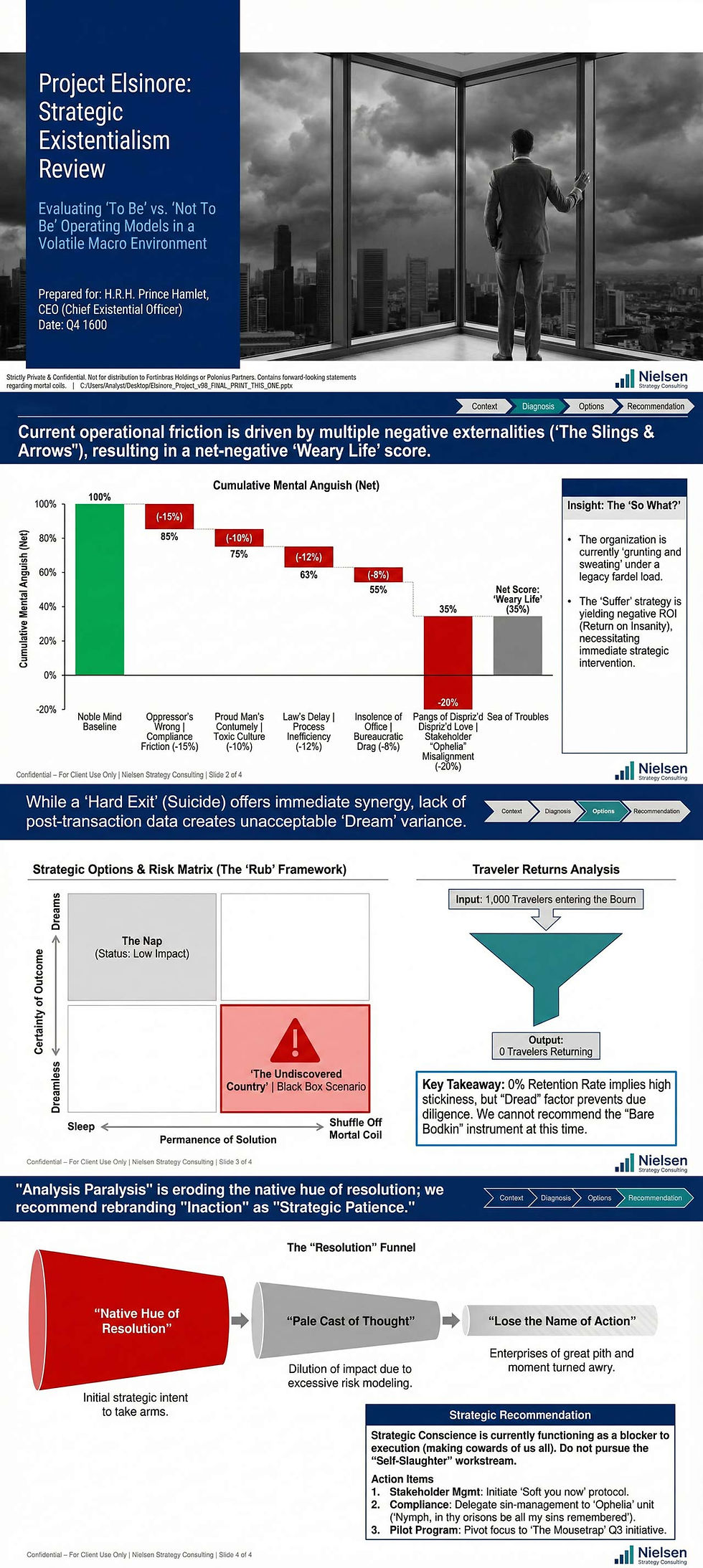

What makes this transformation fascinating is how the medium inherently alters the psychological framing of the content. Hamlet’s soliloquy is a raw exploration of existential dread and paralysis. However, when forced into the rigid format of a consulting slide deck, that profound human emotion is automatically sanitized into sterile, actionable corporate jargon like “Go/No-Go Heuristic Frameworks” and “Strategic Pivots.” This demonstrates that AI isn’t just translating words; it is actively adopting the cultural mindset of the target medium. (This is to your advantage when you want that alternative approach.)
Posters
The next transformations shift from retelling the story to targeting different audiences. A tourist poster treats Hamlet as place branding. A tabloid cover treats it as scandal. A law review turns it into a problem of legitimacy, inheritance, and culpability. A trade magazine filters it through the concerns of a profession. AI is not just changing format here. It is changing the editorial angle.
Posters are a media format optimized for punchy, singular messages. Here are two tourist posters I made for visiting Denmark and seeing Hamlet’s castle.

Tourist poster, 1960s Modern Scandinavian style.

Modern tourist poster.
Newspapers and Magazines
Newspaper front pages and magazine covers are similarly high-impact formats, but they allow more detail than posters and make the editorial angle explicit. Each genre reframes the same story for a different audience.

Clockwise from upper left: Women’s lifestyle, men’s lifestyle, bodybuilding, teen lifestyle.

Clockwise from upper left: Celebrity rag, mainstream news magazine, royalty gossip, supermarket tabloid.

Clockwise from upper left: Law review, fashion magazine, UX professionals’ trade magazine, physicians’ trade magazine.

Clockwise from upper left: Gardening, Popular Mechanics, business magazine, sports.

Newspaper front page.
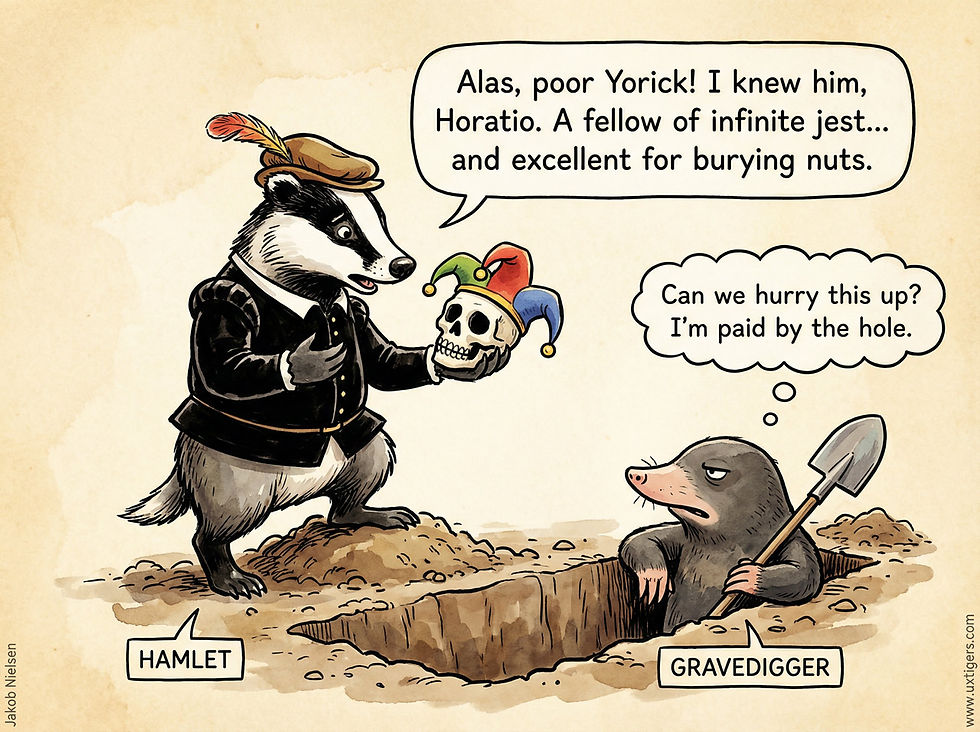
Funny Cartoons
If you subscribe to my newsletter, you know that I am a great fan of funny comics. Here are three based on Hamlet:


Miscellaneous Media Formats
Here’s Hamlet as a snow globe, as a segment from the medieval Bayeux Tapestry (the original of which records the invasion of England by William the Conqueror in 1066), as a science fiction paperback, a collectible doll, and a social media feed.

Hamlet in a snow globe.

Abbreviated plot of Hamlet as a segment of the medieval Bayeux Tapestry. In keeping with the actual tapestry, the Banana wrote the captions in Latin. (Translated, they mean: [1] “Here Hamlet sees the ghost of his father.” [2] “Play of mice,” meaning the Mousetrap play-within-the-play. [3] “Hamlet kills Polonius.” [4] “Ophelia dies in the river.” [5]: “Final duel, and the death of everyone.”) Note the use of the letter “V” for “U,” which is consistent with Latin typography.


This second science fiction paperback book cover was made with the GPT Image 1.5 image model. All the remaining images in this article were made with Nano Banana (Pro or 2 versions).

Ophelia doll.

Prince Hamlet’s social media posts on X (formerly Twitter).
Non-Fiction Storytelling
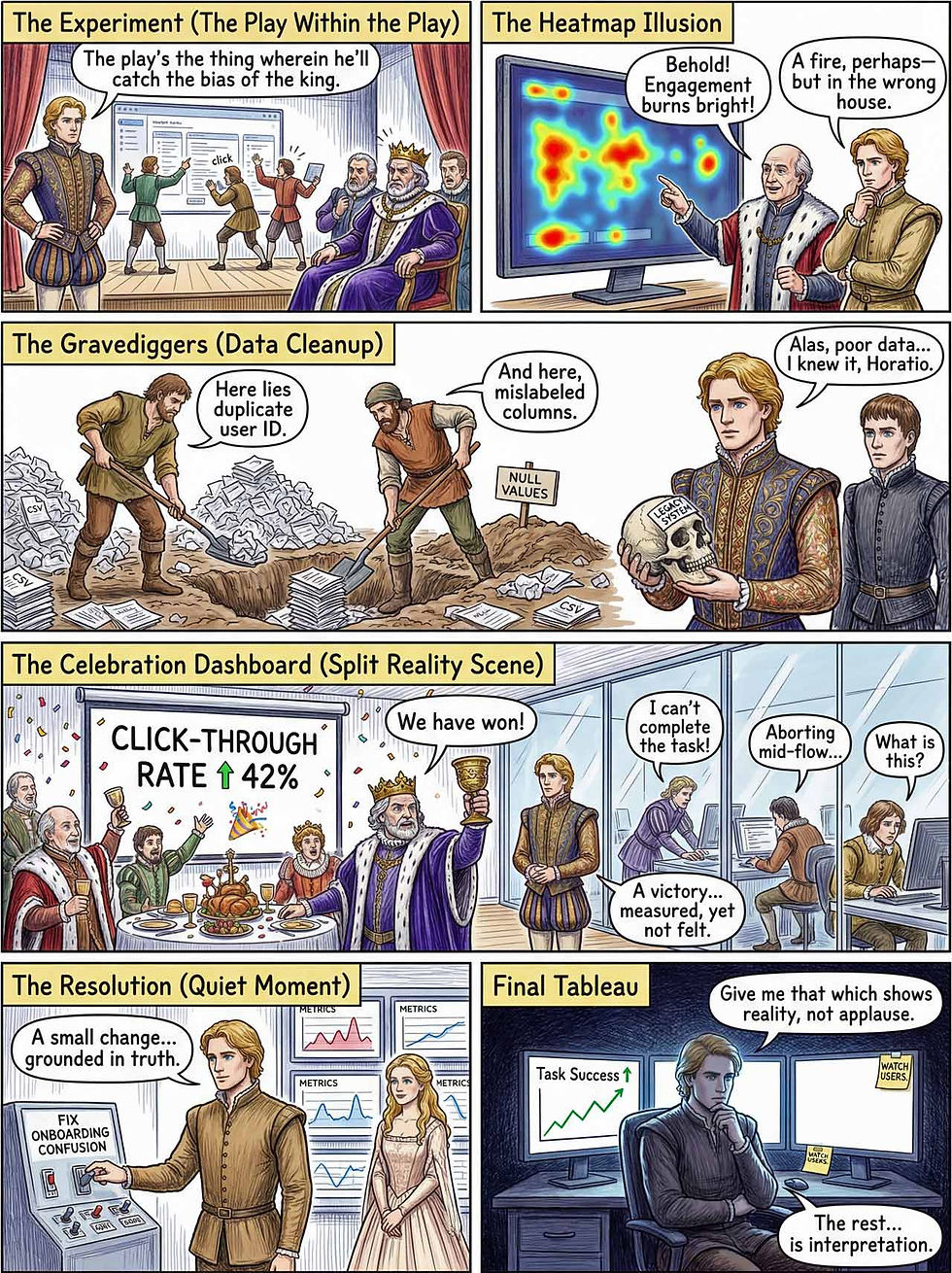
Finally, AI can repurpose the logic of a fictional work into non-fiction. Here I used Hamlet to tell a product-development story about the risk of trusting analytics over user observation.
I made two versions of the comic: one set literally in the modern workplace, the other staged in Renaissance costume inside a present-day company. While absurd, the Renaissance version works better because it preserves immediate recognition of the Shakespearean roles while still carrying the modern analogy.
That is the larger implication for content strategy. One source asset can now generate explanatory, promotional, analytical, and entertaining derivatives at a scale that once required separate teams. But the winning strategy is not to spray the same material across channels. It is to ask what each medium is uniquely good at, then rebuild the content around that strength. AI removes much of the production friction; it does not remove the need for taste, selection, and verification.


Conclusion: From COPE to CORE
For decades, content strategists have chased the holy grail of COPE: Create Once, Publish Everywhere. Historically, this just meant syndicating the exact same text across different platforms. AI introduces a radical upgrade to this philosophy, bringing us into the era of CORE: Create Once, Remix Everywhere.
Transforming Hamlet into a Viking comic book or a UX trade magazine is an entertaining exercise, but it reveals a profound leap forward for cognitive accessibility. Comprehension is a vital component of accessibility. By instantly translating a dense narrative into a visual dashboard, a snappy comic, or an auditory experience, AI allows us to map information to the specific ways different human brains learn. Whether for neurodivergent users, non-native speakers, or visual learners, AI content translation ensures that your core message is never locked behind a single, rigid format.


