
UX Roundup: Old vs New UX | Adam Smith Predicts AI | AI Video | AI Agents

Summary: Books dominated by Old UX instead of new UX | How Adam Smith predicts AI will turn out for the economy | Chinese sci-fi video made with Seedance 2 | The 5 levels of AI agency

UX Roundup for March 16, 2026 (Nano Banana Pro)
Old UX Dominates in New Books; New UX Too Rare
Vitaly Friedman published a list of 21 new books about UX (including some online sources). It’s a useful service to list them all in one place, and several of these new books look interesting, judging from the title. (I’m purely going by the book titles in this analysis, as well as what’s communicated by the 9 book covers Friedman published as an illustration for his list.)
What’s sad is that all these new books seem targeted purely at the legacy UX design process and the design of legacy user interfaces from before the AI revolution started. They could all have been written in 2022, and back then, they would probably have been useful for UX newbies by teaching them the practices that were indeed the best practices in the BA (before AI) era.
However, in the AA (after AI) era, everything has changed in two ways:
The UX design process has been accelerated by AI use, changing the best practices. For example, we should reverse the creative workflow and start by creating the final polish rather than rough sketches. Similarly, ideation is free with AI, so we should explore the design space in much greater breadth than would ever have been feasible with manual design. Creation has become discovery, as we navigate latent design space.
The design product (the user interface) is based on an AI foundation, resulting in either intelligent interfaces (pre-designed), generative UI (designed on the fly by AI), or even UI-less computation where services are used by AI agents rather than by humans. Whereas accessibility was important in the old world, it becomes irrelevant in the latter case (since only the AI agent uses the service), and is handled by AI in the middle case, making it a non-issue for the human designers who guide the generative UI system. (The designers of the underlying generative UI systems and of the AI agents do need to understand accessibility, of course, but only a few hundred UX people will have these roles, corresponding to 0.01% of the world’s UX professionals. The remaining 99.99% should focus on the new world of design.)
I do know of books that focus on these two more critical issues, such as “Sentient Design” by Josh Clark and Veronika Kindred, and “UX for AI: A Framework for Designing AI‑Driven Products” by Greg Nudelman.
But the balance is dramatically skewed toward the old world of UX rather than the new world that UX professionals (whether newbies or senior staff) need to learn now. Just counting the number of titles yields a 10-to-1 ratio in favor of old insight over emerging best practice.
Buyer beware. You will learn something useful from legacy sources, so I don’t warn against reading a few of them. However, you should focus most of your learning on the future rather than the past. As I calculated, the odds of learning what you need are against you, unless you deliberately seek out learning materials that are new-world-focused.
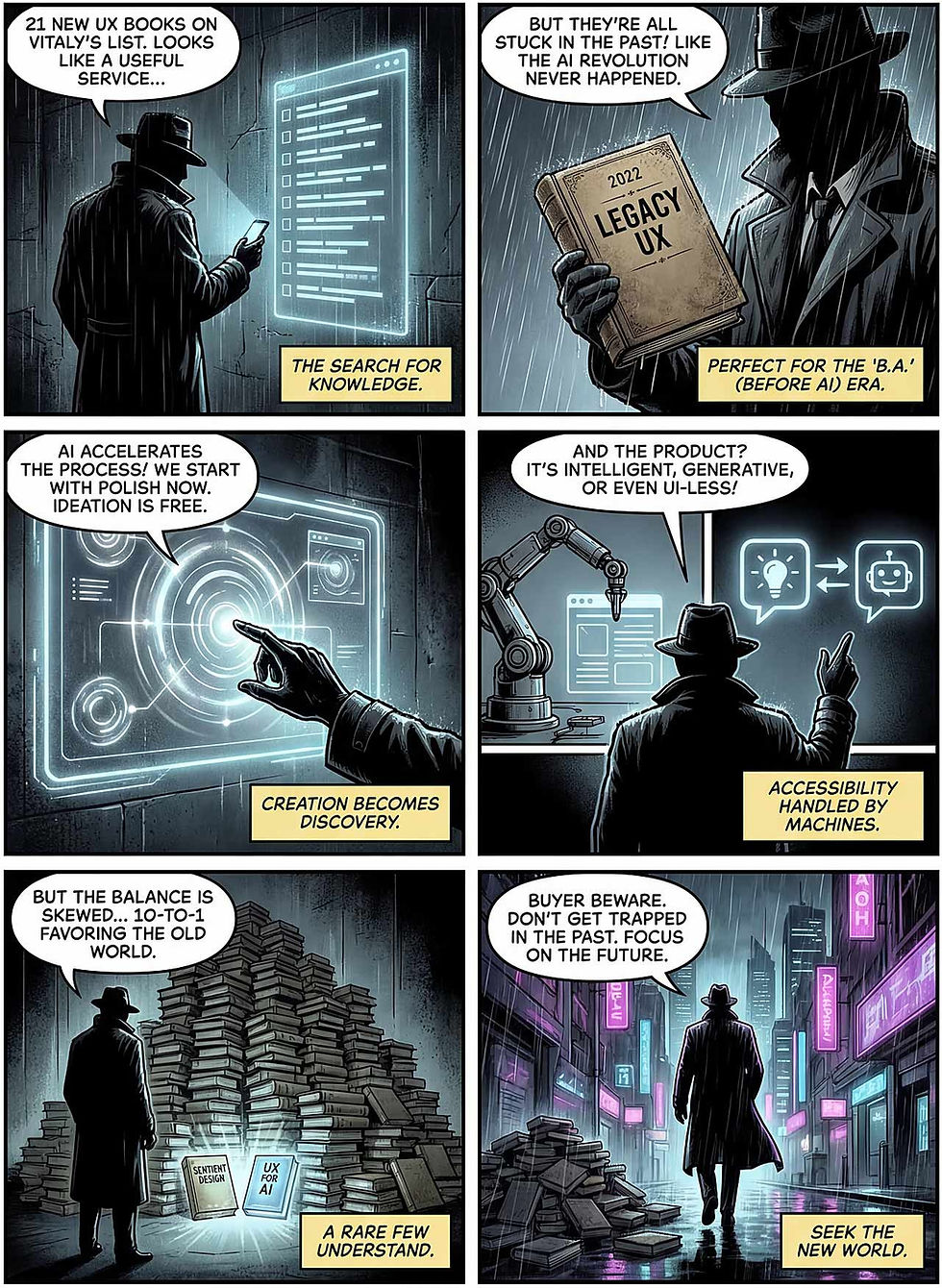
My admittedly simplistic metric of counting the titles of recent sources targeting old vs. new UX shows that the odds are distinctly against you, unless you deliberately seek out learning materials that deeply understand the new world of AI. (Nano Banana Pro)
Adam Smith and AI
Last week, we celebrated the 250th anniversary of the publication of Adam Smith’s “An Inquiry into the Nature and Causes of the Wealth of Nations” on March 9, 1776. The book is more commonly referred to simply as “The Wealth of Nations” and is probably the second-most important book ever written. (I would rank Charles Darwin’s The Origin of Species as even more important. Biology beats economics.)

Adam Smith’s classic foundation of economics is 250 years old. How do its insights translate into the modern world of AI? (Nano Banana 2)
In case you never studied economics, here’s a short recap of the main ideas from The Wealth of Nations as a comic strip made with Nano Banana 2. While these points seem obvious to us today, they were revolutionary in 1776 when Scotland worked on the basis of inherited privilege.


What can we learn from applying Adam Smith’s foundational insights into how an economy works to the current AI revolution? When Adam Smith published The Wealth of Nations in 1776, he was observing the dawn of the First Industrial Revolution. He watched as muscular labor was broken down, optimized, and eventually augmented by machinery. Today, in 2026, AI is doing to cognitive labor what the steam engine did to physical labor. By viewing AI not as a sci-fi entity, but strictly as a new form of capital, we can use Smith’s insights to predict how AI will reshape the global economy and human society over the next decade.

AI today is the equivalent of the steam engine in 1776. (Seedream 5.0 lite)
1. The Pin Factory 2.0: The Cognitive Division of Labor
Smith’s Insight: The opening of The Wealth of Nations famously describes a pin factory. Smith observed that a single unspecialized worker might make one pin a day. But by dividing the work into 18 distinct operations (drawing the wire, cutting, heading, etc.), ten workers could produce 48,000 pins a day. The division of labor is the primary driver of productivity and wealth.
AI Reality Today: AI is facilitating the ultimate division of cognitive labor. Generative AI models and agentic workflows are breaking down complex knowledge work into hyper-specialized micro-tasks. Software development is no longer done by one coder writing from scratch; it is divided between AI generating boilerplate, AI testing for bugs, and a human orchestrating the architecture.

Intelligence becomes so abundant that it’s virtually free. (Nano Banana 2)
Decade Predictions (2026–2036):
Hyper-Productivity: Just as pins became incredibly cheap and abundant, intelligence and content will become effectively free. We will see a massive deflationary effect on the cost of legal analysis, medical diagnostics, basic coding, and copywriting.
The Rise of the Human Orchestrator: Smith noted that division of labor shifts the worker's role. Over the next decade, humans will largely stop “making the pins” (writing raw code, drafting legal briefs) and become managers of AI agents. Economic premiums will flow to those who can string together specialized AI models to solve complex problems.

The human role becomes that of orchestrating AI agents. Interestingly, old-school middle managers who know how to divide up work and ensure that their underlings deliver in a coordinated fashion may enjoy a renaissance as “conductors,” even as their role as people managers vanishes with smaller teams in the future. (Nano Banana 2)
Long Tail and Superstars Coexist: When cognitive services become cheap, global, and instant, tasks that were never worth automating become worth automating. AI will likely create a long tail of tiny firms, solo operators, and niche tools, because small actors can now rent capabilities that once required departments. At the same time, it will intensify superstar effects, because the best integrated workflow, the most trusted brand, or the most efficient distribution channel can scale globally at almost no marginal cost. In Smith’s framework, those are not competing stories. Bigger markets always support finer specialization, and finer specialization often increases the spread between ordinary producers and the best ones.

AI will create an immense outpouring of small, niche firms while also supporting giant companies. That’s fine; we need both. (Nano Banana Pro)
2. Machinery and Fixed Capital: AI as “Mind-Machines”
Smith’s Insight: Smith categorized machines as “fixed capital” that increases the productivity of labor. He believed that while machines might displace workers in the short term, they ultimately create more wealth, lower the cost of goods, and create new, higher-level employment, benefiting the working class in the long run. (This clearly happened exactly as predicted during these last 250 years. Average workers enjoy substantially higher standards of living today than in 1776, and there is very little unemployment despite virtually all jobs that have existed during the last 250 years being made obsolete by progress.)
AI Reality Today: Foundational models are highly concentrated forms of fixed capital. They require billions of dollars in compute (GPUs) and energy to train. They are being deployed to substitute human labor in white-collar sectors.
Decade Predictions (2026–2036):
Short-Term Displacement, Long-Term Abundance: Following Smith’s logic, the next 5 to 10 years will see significant structural unemployment and wage stagnation in mid-level cognitive tasks (paralegals, data analysts, technical writers, pixel-pushing designers). However, the cost of living will plummet, particularly in services historically immune to automation, like personalized education and preventative healthcare.

In the short term, huge numbers of legacy jobs will be eradicated. In the long term, AI will create an abundance society, with greater emphasis on human values than on mass-scale labor. (Nano Banana 2)
The Paradox of Human Premium: As AI drives the cost of cognitive production to near zero, Smithian economics suggests that human capital will pivot to what is scarce. Over the next decade, profound economic value will shift toward emotional intelligence, high-stakes decision-making, and human-to-human empathy (nursing, hospitality).

Humans will specialize in being human. The one thing AI can’t do! (Nano Banana 2)
3. Monopolies and Regulatory Capture: The Threat of “Tech-Mercantilism”
Smith’s Insight: Smith deeply distrusted monopolies and mercantilism (crony capitalism). He famously warned: "People of the same trade seldom meet together, even for merriment and diversion, but the conversation ends in a conspiracy against the public, or in some contrivance to raise prices." He warned that powerful corporations would try to use the government to create barriers to entry.
AI Reality Today: The AI industry is heavily trending toward an oligopoly. The massive capital required to train frontier models creates a natural moat. Furthermore, there is an ongoing debate about “AI Safety,” where some politicians (whether naïve or evil) seek to introduce stringent regulations, licensing, and bans on AI use.

In the 18th Century, entrenched guilds and companies used regulations and trade barriers to keep out competition, to the detriment of the people, in a system known as mercantilism. Special interests are currently trying to revive this playbook with AI. (Nano Banana 2)
Decade Predictions (2026–2036):
Regulatory Capture Disguised as Safety: Through Smith’s cynical lens regarding corporate motives, the push for AI regulation over the next decade will be aggressively co-opted by both tech giants and legacy providers of existing services (e.g., in healthcare and education) who seek to avoid being disrupted. Licensing requirements for AI models will be used to crush open-source competitors and startups, possibly leading to a period of “AI Mercantilism” and stagnation in the US (hopefully not) and EU (sadly quite likely), while China goes full steam ahead.
Antitrust Resurgence: The inherent conflict between closed-source AI monopolies and the public interest will trigger massive antitrust actions in the 2030s. Governments will increasingly view foundational AI models as public utilities rather than private software, leading to forced breakups or enforced open-access mandates.
4. The “Invisible Hand” vs. The Alignment Problem
Smith’s Insight: The “Invisible Hand” posits that individuals pursuing their own self-interest unintentionally promote the good of society. The butcher and the baker provide us dinner not out of benevolence, but out of regard to their own interest. Prosperity and coordination are created by the “invisible hand” of millions of people collaborating voluntarily, even though they work for their own interests in the free market.
AI Reality Today: The race for Artificial General Intelligence (AGI) is being driven entirely by the self-interest of tech companies and venture capitalists seeking trillion-dollar market caps.
Decade Predictions (2026–2036):
The Ultimate Test of the Invisible Hand: Over the next decade, we will discover if Smith’s core thesis holds true for intelligence itself. Will the pursuit of corporate profit via AI inherently result in tools that uplift humanity? Smith’s theory suggests it will, because a tool is only profitable if society finds it useful. Therefore, AI companies are economically incentivized to make AI that is highly aligned, safe, and helpful to humans: malevolent or hallucinating AI does not generate sustainable revenue.

AI will be aligned with human interests for the simple reason that the best way to make long-term profits is to make something users want. (Nano Banana 2)
The Friction of Unintended Externalities: Smith acknowledged that markets fail when there are massive external costs. AI-generated misinformation, deepfakes, and automated cyberattacks will test the limits of the Invisible Hand. The market will naturally spawn a lucrative counter-industry: AI verification, cryptographic truth-checkers, and digital immune systems.

Evil AI will attack us through deepfakes, phishing, and new attack vectors yet to be invented. The best defense is more AI. (Nano Banana 2)
5. The Degradation of the Mind and the Role of Education
Smith’s Insight: Often overlooked by modern readers is Smith’s dark warning about the division of labor. He wrote that a person whose life is spent performing a few simple operations “generally becomes as stupid and ignorant as it is possible for a human creature to become.” To counteract this degradation of the human spirit, Smith strongly advocated for public education.
AI Reality Today: As AI takes over average thinking (writing emails, summarizing documents, drafting reports), humans are outsourcing their cognitive heavy lifting. We are arguably losing our cognitive stamina.
Decade Predictions (2026–2036):
The Crisis of Cognitive Atrophy: Just as the industrial revolution made us physically sedentary, the AI revolution threatens to make us cognitively sedentary. If an AI always provides the optimal answer, the human muscle for critical thought may atrophy.

The main risk of AI is that it becomes so good that people give up thinking for themselves, leading to cognitive atrophy. Humans are inherently lazy animals. (Nano Banana Pro)
A Renaissance in Education: Applying Smith’s remedy, the role of education over the next decade must dramatically shift. Because rote memorization and basic analytical tasks are now solved by AI, education will be forced to undergo a total paradigm shift. Schools will have to pivot away from teaching students how to compute or memorize, and toward philosophy, ethics, abstract reasoning, and physical interaction, which are relative human strengths compared to AI capabilities.
The New Public Goods: Smith argued the state should provide public works that are beneficial to society but unprofitable for individuals to build (like roads and bridges). In the 2030s, “human cognitive infrastructure” will become a Smithian public good. This may take the form of state-subsidized offline spaces, cognitive training programs, or new civic institutions designed to preserve human meaning in an age where economic utility is dominated by machines.

We face the sublime, now with the challenge of reaching the new summits that open up with new opportunities. With apologies to Caspar David Friedrich. (Nano Banana Pro)
The Ultimate Culmination of Smith’s Machine
If Adam Smith were alive today, he would not view AI as magic. He would see it as the pinnacle of the economic forces he described in 1776. AI is the ultimate division of labor; it is the most potent form of fixed capital ever invented; and it is subject to the exact same risks of monopoly and worker dislocation as the looms and steam engines of the 18th century.

It’s amazing how much of Adam Smith’s thinking from 250 years ago applies to the current AI revolution. The parallels are strong. I am hopeful that the outcome of our current upheavals will be as beneficial to humanity as the upheavals of Smith’s time. Also, since we are now forewarned, we can avoid some of the temporary setbacks that resulted back then. (Seedream 5 lite)
Smith’s framework predicts that the next decade will be chaotic. We will experience massive friction between labor and capital, and intense rent-seeking by legacy providers, such as doctors and teachers. However, Smith’s underlying optimism remains: by turning human intelligence into cheap, abundant capital, AI will ultimately trigger a vast expansion in the wealth of nations.
The defining challenge of the next decade will not be a lack of resources, but rather ensuring that the massive wealth generated by the new Invisible Hand benefits all citizens, and that humanity finds a new sense of purpose when the burden of cognitive labor is finally lifted.

Untold prosperity awaits. Adam Smith would probably not have believed how rich the average person is today, compared with Edinburgh in 1776, and we may not believe how affluent we’ll all be in twenty years. But it happened once, and it will happen again. Just faster. (Nano Banana 2)
Chinese Sci-Fi Video Made with Seedance 2
The Chinese video model Seedance 2.0 continues to deliver great-looking output. Since it’s still mostly available only in China, we don’t see many examples from Western creators. A creator named 沐阳 recently posted some good-looking short science fiction films made with Seedance 2.
Thanks to AI translations of social media posts, we can read the posts in English, but video clips don't seem to be translated yet, so I couldn’t follow the plot of these mini-movies.
From just watching, the visuals are stunning and up to the special effects of most feature-length SF movies produced by legacy Hollywood studios, except for the very best ones, such as 2001, the original Star Wars, and Blade Runner. Lip synch seems decent, but not perfect, though this is hard for me to judge since my Mandarin doesn’t extend past xièxie.

Since the best AI video is Chinese, foreigners currently have difficulty following the plotlines. (Nano Banana Pro)
Not understanding what’s being said, I cannot fairly judge the plot, but the visuals make it seem simplistic. (Chinese-speaking subscribers: please watch and let me know in the comments how good the storytelling is in these videos.)

Storytelling seems to be a weak point for AI movies so far. (Nano Banana Pro)
For now, AI movies are probably best suited to this episodic mini-movie format: new episodes released frequently, each limited to less than five minutes, which may be the max duration for maintaining viewer engagement without more sophisticated plots.
Somewhat like the old Lone Ranger, Flash Gordon, and Zorro’s Fighting Legion movie serials of the 1930s, which were shown in theaters before the main feature film. A complete serial usually had around 15 chapters, and even though several had a science-fiction theme, others were westerns or period dramas like Zorro. If this historical analogy holds for the new media form of AI shorts, expect a broader range of genres and long runs of episodes. (The early examples of AI short movies are dominated by SF and fantasy because the first AI creators have mostly been nerds. As we get more “normal” film creators, expect topics to broaden.)

Early AI movies are dominated by nerdy themes. (Nano Banana Pro)

My prediction: A broader range of genres coming to AI video soon. Since Netflix refuses to make historically accurate period dramas, this genre is particularly ripe for disruption. (Nano Banana Pro)
5 Stages of Agentic Commerce
Stripe is a third-party service that processes payments for ecommerce sites. Stripe recently published its 2025 annual letter (13-page PDF), and while the full document is worth reading, the section about agentic commerce is particularly interesting. While ecommerce is only one element of the economy, Stripe notes that US brick-and-mortar sales grew just 5% over the past 3 years, whereas ecommerce sales grew 30% over the same period (both in inflation-adjusted terms), so ecommerce is growing in importance and likely signals where the economy at large is headed in the era of AI agents.
Stripe treats agentic commerce as the stage where autonomous or semi-autonomous AI agents not only recommend but also initiate and complete transactions across many merchants and interfaces. This is framed as analogous to the early web: the key constraint is not model capability per se, but interoperability between many agents and many businesses.
A central claim is that success requires a universal “financial language” so any agent can safely transact with any compatible business, regardless of the front-end interface or underlying payment processor. Stripe explicitly links this to its long-term vision as “economic infrastructure for AI,” not just a payments API.
Much of today’s AI excitement centers on tool use: models that do more than reason over training data and can search, browse, run code, and act online. In commerce, that means AI buying on your behalf. The concept has been overhyped, so it helps to see agentic commerce as a gradual progression.
The best part of Stripe’s report is the following conceptualization of AI agents into 5 levels of agency (how much they do on behalf of the user):
Level 1: Eliminating web forms
You decide what to buy, but your agent handles checkout. Send it a URL, and it fills in payment and shipping details, clicks “buy,” and returns with confirmation. It makes no decisions; it simply executes.
Level 2: Descriptive search
You describe your situation instead of typing keywords. The system reasons across weather, materials, size, durability, taste, reviews, and delivery speed, making specialized and long-tail products much easier to find.
Level 3: Persistence
You stop reintroducing yourself. The system remembers your preferences and requirements from past conversations and purchases. You still decide what to buy, but the options already reflect your taste and budget.
Level 4: Delegation
You stop choosing. The system searches, evaluates options, and buys on your behalf. You trust it to balance trade-offs as you would. Your main job is setting the budget.
Level 5: Anticipation
There is no prompt. The system already knows your situation and preferences, and your usual budget. You simply get a notification that everything needed has already been purchased.
Today, the industry sits between levels 1 and 2. This feels like the mid-1990s Internet, when browsers, protocols, and platforms were still unsettled, and no one knew what would dominate. Agentic commerce will prove similarly consequential, but only if the ecosystem becomes interoperable. Progress through these five levels depends on systems working together.
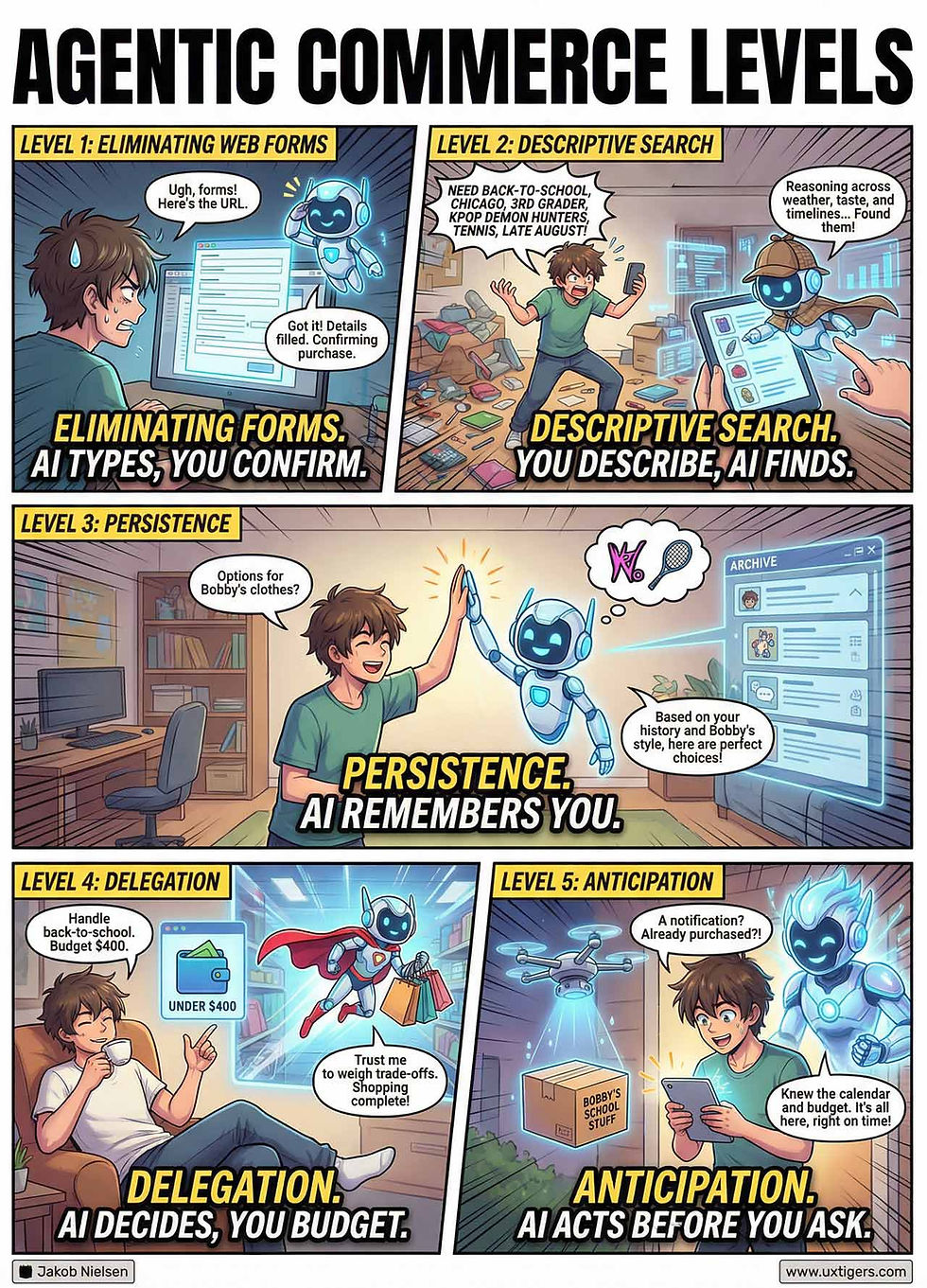
The five levels of agentic commerce according to Stripe. Most current AI agents are only at level 1 and are about to progress to level 2. However, in planning for your future online strategy, assume that many agents and users will prefer levels 4 and 5: that’s the “No UI” future. (Nano Banana Pro)
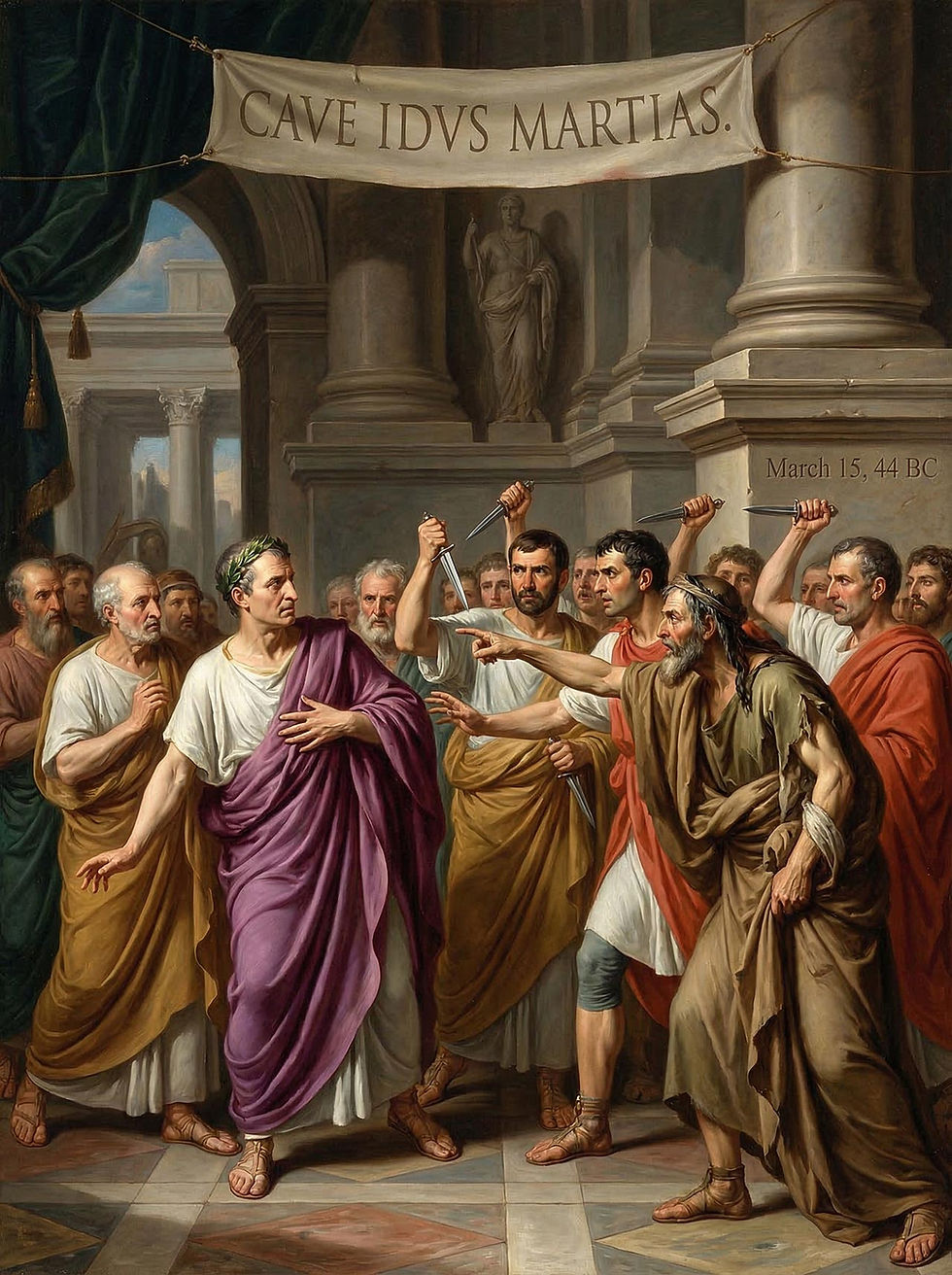
Remembering Julius Caesar: 4 Styles
Yesterday was the day!

(Nano Banana 2)
(Nano Banana Pro)

(Seedream 5 lite)

(Nano Banana 2)


